
Where Hidden Water Leaks Hide in Your Home (And How to Find Them Early)
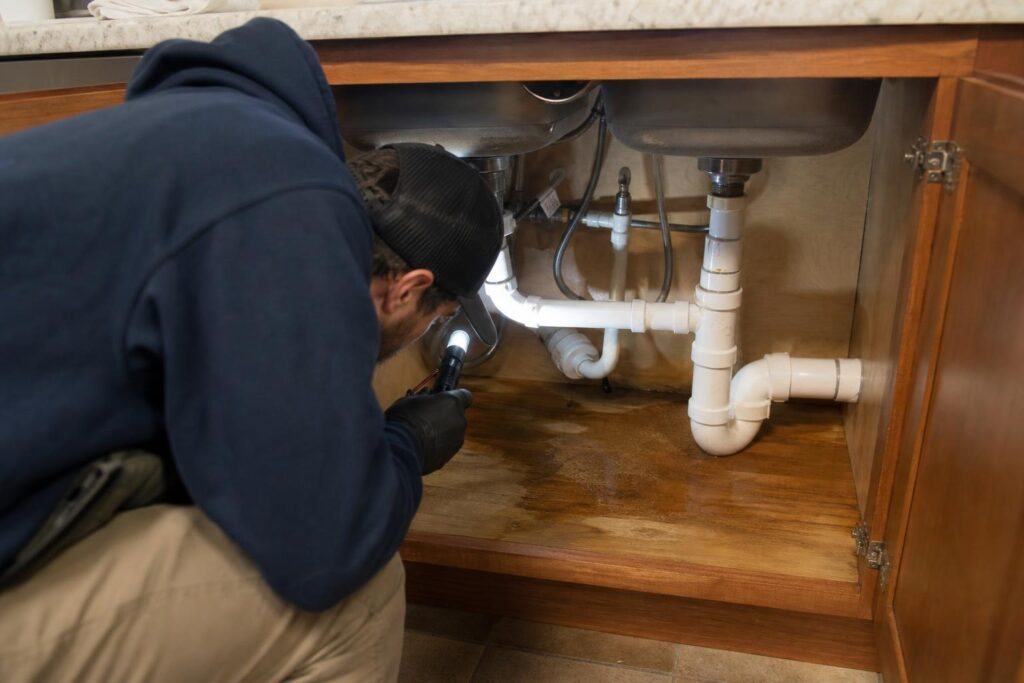
Hidden water leaks usually hide in nine places: under kitchen and bathroom sinks, behind and beneath toilets, at appliance supply lines, inside cabinet and vanity floors, under and around the water heater, behind shower and tub valves, in crawl spaces and basements, at outdoor hose bibs, and inside walls where supply lines run. Most start as a slow drip you can't hear. You usually notice the damage — a soft cabinet floor, a musty smell, a water bill that jumped — before you ever see the leak itself.
The good news: nearly every spot on that list is one you can check yourself in about 20 minutes. This guide walks through each one, what to look for, and when it's time to bring in a licensed plumber.
Signs of a hidden leak before you ever see water
A leak announces itself in small ways first. If two or more of these sound familiar, you likely have water moving where it shouldn't:
- A water bill that climbed with no change in how you use water
- The sound of running or trickling water when every fixture is off
- A musty or earthy smell in a bathroom, kitchen cabinet or laundry room
- Warped, swollen or discolored particleboard at the bottom of a cabinet
- Peeling paint, bubbling drywall, or a stain that keeps coming back
- Floor tile or vinyl that's lifting or feels spongy
- Drop in water pressure at one or more fixtures
- Mold or mildew in a spot that stays dry to the touch
- A warm patch on a concrete floor (possible hot-water slab leak)
None of these prove a leak on their own. Together, they're worth a look.
The 9 places hidden leaks hide
1. Under kitchen and bathroom sinks
This is the most common hiding spot, and the easiest to miss. Clear everything out of the cabinet and run your hand along the supply lines, the shutoff valves, the P-trap and the drain tailpiece. Dry pipes are good. Damp, crusty white mineral buildup or a green ring on a valve means water has been escaping slowly for a while.
Check the cabinet floor itself, especially the back corners and the seam where the base meets the wall. Water runs downhill and pools where you can't see it.
2. Behind and under toilets
Toilets leak in two directions. Inside the tank, a worn flapper lets water run into the bowl continuously — that's the quiet, expensive leak that shows up on your bill, not your floor.
Outside, look at the base. A toilet that rocks slightly, or has a persistent damp ring or discolored flooring around it, is likely leaking at the wax seal. That water goes straight into the subfloor. Also check the supply line and fill valve at the back of the tank.
Quick test: put a few drops of food coloring in the tank. Wait 15 minutes without flushing. If color shows up in the bowl, the flapper is leaking.
3. Appliance supply lines
Dishwashers, refrigerators with ice makers, and washing machines all run on hoses that age quietly behind a heavy appliance nobody moves.
- Dishwasher: check the floor at the front edge and the supply line under the adjacent sink cabinet.
- Refrigerator: pull it out and look at the small water line and the shutoff valve behind it.
- Washing machine: inspect both hot and cold hoses for bulges, cracks or rust at the connections.
A rubber hose that feels stiff or looks swollen is on borrowed time.
4. Inside cabinets and vanities
Cabinet and vanity boxes are often particleboard, which absorbs water and hides it. The surface can look fine while the material underneath is saturated.
Press firmly on the cabinet floor. If it gives, flakes, or feels soft, water has been sitting there. Same with the underside of a vanity drawer or the toe kick at the bottom of a cabinet run.
5. Around the water heater
Look at the floor under the tank, the drain valve at the bottom, the temperature and pressure relief valve, and the hot and cold connections up top. Rust streaks down the side of the tank or a damp spot on the pan usually means the tank is failing, not just dripping.
A small puddle under a water heater rarely stays small. If yours is leaking, it's worth asking about repair versus replacement — including a tankless option — before it lets go.
6. Behind shower and tub valves
Leaks here happen inside the wall, so you look for evidence instead. Check the wall on the opposite side of the shower for soft drywall, staining or bubbled paint. Check the ceiling below an upstairs bathroom. Look at the caulk and grout lines in the shower for cracks that let water past the surface.
7. Crawl spaces and basements
Grab a flashlight. You're looking for wet insulation, drips at pipe joints, standing water, or mud that stays wet in dry weather. Crawl space leaks can run for months without a single sign upstairs — until the floor starts to feel soft or the smell reaches you.
8. Outdoor hose bibs and irrigation
Turn each outdoor spigot on and off, then check for dripping at the handle and at the wall connection. A hose bib that leaks back into the wall is a hidden interior leak with an outdoor cause. Irrigation lines that fail underground often show as a patch of grass that's greener or soggier than the rest.
9. Inside walls and under slabs
These are the leaks you can't inspect yourself. The clues are indirect: running-water sounds, unexplained water use, a warm spot on the floor, or a stain that spreads. This is where professional leak detection earns its keep — locating the leak precisely instead of opening walls to guess.
The water meter test: confirm a leak in 2 hours
If you suspect a leak but can't find it, your water meter will tell you.
1. Turn off every faucet, appliance and fixture in the house. No dishwasher, no laundry, no irrigation.
2. Find your water meter and write down the reading. Note whether the small leak indicator dial is moving.
3. Wait one to two hours with no water use at all.
4. Read the meter again.
If the number changed, water is leaving your system somewhere. That's a leak, and now it's about finding it.
Is a slow drip actually urgent?
It depends on where the water is going.
Call right away if:
- Water is actively pooling, spraying or running
- You see water near an electrical panel, outlet or fixture
- The water heater is leaking from the tank body
- A ceiling is stained, sagging or dripping
- You've shut off water at a fixture and it still leaks
Schedule a repair soon — days, not months — if:
- A faucet or showerhead drips steadily
- A toilet runs intermittently
- There's slow dampness under a sink with no active drip
- Your water bill went up and the meter test confirmed movement
The reason slow leaks matter isn't the water itself. It's what sits wet underneath it: subfloor, joists, cabinet bases and drywall. Repair costs climb when the damage moves from the pipe to the structure around it.
How professional leak detection and repair works
Einstein Pros provides leak detection, water leak repair, pipe repair and whole-home repiping across Oregon and Washington. The goal is to find the source with the least disruption possible, then fix it properly and to code.
Here's what the process looks like on a typical call:
- Confirm and locate. A licensed technician traces the leak to its actual source, not just the spot where water surfaced.
- Explain the problem in plain language. You'll hear what failed and why.
- Quote before work starts. Upfront flat-rate pricing, provided before any work begins.
- Repair to code. That may be a fixture or supply line replacement, a section of pipe repair, or in older homes with repeat failures, a repiping plan.
- Clean up. Clean job sites, every time.
What to expect on every job: clear scheduling confirmation, licensed and insured technicians, upfront flat-rate pricing, respectful and professional service, clean job sites, and transparent communication.
Same-day or next-day service is available in many cases, depending on availability and urgency. Emergency plumbing service is available throughout Central Oregon, Portland, and Washington communities including Vancouver, Tacoma, Seattle, Belfair and Silverdale. In Bend, Tacoma and Puyallup, emergency response is available 24/7.
Common questions about hidden leaks
Can a running toilet really raise my water bill that much?
Yes. A running toilet passes water continuously, day and night, without ever showing up on your floor. It's one of the most common causes of a water bill that jumps with no change in household habits. Toilet repair and installation is a routine fix.
I found the leak. Do I need to repipe the whole house?
Usually not. A single failed supply line, valve or fixture connection is a targeted repair. Repiping becomes worth discussing when you're seeing repeat leaks in different places, ongoing pressure problems, or aging pipe throughout the home. A technician can tell you which situation you're in before you commit to anything.
What if my water pressure is also off?
Low or fluctuating pressure alongside a suspected leak is worth mentioning when you schedule. It can point to a leak upstream, or to a pressure regulation issue. Water pressure regulation is part of the service list.
Can you find a leak that's under a concrete slab?
Slab leaks are located through professional leak detection rather than exploratory demolition. If you have a warm spot on the floor, running-water sounds with everything off, or a confirmed meter test with no visible source, describe those symptoms when you call. They help narrow it down before a technician arrives.
Stop the drip. Stop the waste.
Right now, qualifying leak repairs are 5% off. If you've found a drip under a sink, a toilet that keeps running, damp cabinet floors, or a water bill you can't explain, get it looked at while it's still a small repair.
Use the schedule a job estimate page to request service online — the team aims to respond quickly, often within minutes during business hours. Or call directly:
- Central Oregon (Bend, Redmond, Sisters, Sunriver, La Pine, Prineville, Madras): (541) 420-8888
- Portland & Vancouver, WA: (503) 821-4070
- Salem, OR: (503) 837-8470
- Tacoma, Seattle, Puyallup, Bremerton, Silverdale, Port Orchard & Belfair: (253) 533-9060
- Toll-free: (888) 671-7767
Office hours are Monday through Friday, 7:30 a.m. to 4:30 p.m., except holidays. Licensed and insured technicians. Upfront flat-rate pricing before work begins.
Book your leak repair and save 5%.