
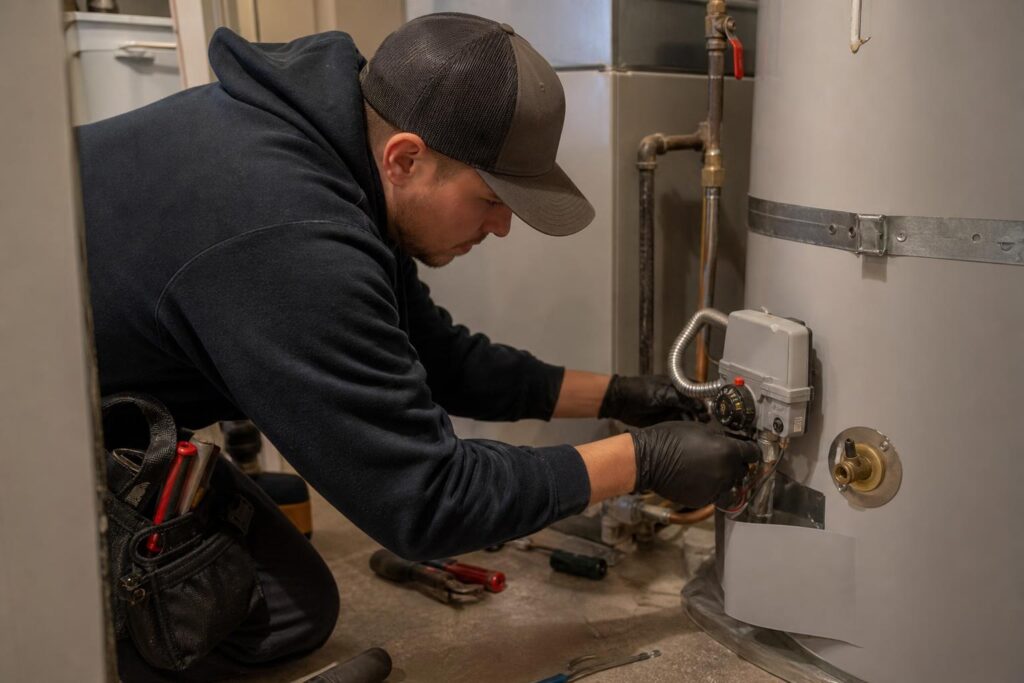
Gas Water Heater Repair vs. Replacement in Tacoma: How to Decide
If your gas water heater is under about 8 years old and the problem is a single failed part — a pilot that won't stay lit, a bad thermocouple, a faulty gas control valve, a leaking supply connection — repair is almost always the right call. If the tank itself is leaking, or the unit is past 10 years and you're paying for a second or third repair, replacement is the better use of your money. Everything else comes down to three things: the age of the unit, where the water is coming from, and how much the repair costs compared to a new heater.
Below is how a licensed plumber actually works through that decision, plus the warning signs worth acting on before winter hits.
Start here: is the tank leaking, or is it something else?
This is the single most important question, and it decides most cases on its own.
Water pooling at the base of the tank usually means the steel tank has corroded through from the inside. That can't be patched. Once a tank fails, the only fix is replacement.
But not every puddle means a dead tank. Check these first:
- The drain valve at the bottom — these drip and can be replaced.
- The temperature and pressure relief (T&P) valve and its discharge pipe — a dripping T&P valve can point to high pressure or a bad valve, both repairable.
- The cold inlet and hot outlet connections at the top — fittings loosen and corrode, and water runs down the side of the tank, making it look like the tank failed.
- Condensation — a lot of cold incoming water on a cold morning can sweat a tank. It looks alarming and isn't.
If the water is coming from a fitting or a valve, you're in repair territory. If it's weeping from the body of the tank or from the seam at the bottom, you're replacing it.
Warning signs your gas water heater is telling you something
Most water heaters give you weeks or months of notice. Here's what to watch for and what each sign usually means.
Signs that usually point to a repair
- Pilot light won't stay lit. Often a thermocouple, a dirty pilot assembly, or a gas control valve issue.
- No hot water at all, but the unit is relatively new. Frequently an ignition or gas control problem.
- Water is scalding or never hot enough. Thermostat or gas valve calibration.
- A small drip from a valve or fitting. Replaceable hardware.
- Hot water runs out faster than it used to, with no other symptoms. Often sediment buildup or a failed dip tube — both fixable.
Signs that usually point to replacement
- Rust-colored or metallic-smelling hot water. Interior corrosion that's progressed past the anode rod's ability to protect the tank.
- Rumbling, popping or banging during the heating cycle. Sediment baked onto the bottom of the tank. It can sometimes be flushed early on, but in an older unit it means the tank has been overheating its own steel for years.
- Visible rust on the tank jacket or around the bottom seam.
- Water on the floor under the tank body.
- Two or more repairs in the last couple of years.
- Age past 10–12 years with any new symptom.
Signs to treat as an emergency
- You smell gas near the heater. Don't flip switches. Leave the house, then call your gas utility from outside. Once the gas side is safe, call a licensed plumber.
- A burst connection or a fast leak flooding the space. Shut off the cold water supply to the heater and the gas, then call for emergency service.
We offer 24/7 emergency plumbing response in Tacoma, with same-day service available.
The age test
A tank-style gas water heater has a working life measured in years, not forever. As a practical rule:
- Under 6 years: Repair. The tank has plenty of service left and parts are the likely culprit.
- 6 to 10 years: Repair if the fix is straightforward and the tank is sound. Start budgeting for replacement.
- Over 10 years: Weigh the repair cost against a new unit. A significant repair on a 12-year-old heater often buys you a year or two, not a decade.
- Tank is leaking at any age: Replace.
If you don't know how old yours is, the manufacture date is usually encoded in the serial number on the rating plate. A plumber can read it for you in about ten seconds.
The cost comparison that actually matters
The honest question isn't "how much is the repair?" It's "how much hot water does this repair buy me?"
A $200 part on a 4-year-old heater is excellent value. The same $200 part on a 13-year-old heater with a rusting jacket is money spent on a unit that may leak next winter — and a tank failure in a finished basement or a Proctor District crawl space costs far more than the heater did.
We give you upfront flat-rate pricing before any work begins, so you see the repair number and the replacement number side by side and decide with real figures in front of you. No guessing mid-job. Financing options may be available for qualifying projects — ask the team about approval requirements.
Should you replace with another tank, or go tankless?
Both are legitimate choices, and we install and service traditional and tankless water heaters.
Stick with a tank if:
- You want the most direct swap with your existing gas and venting setup.
- Your household's hot water demand is steady and predictable.
- Upfront cost is the priority.
Consider tankless if:
- You run out of hot water with back-to-back showers or a big laundry day.
- You want the floor space back.
- You're planning to stay in the home long enough to care about long-term efficiency.
Tankless conversions involve more than setting a new box in the same spot — gas supply sizing and venting both need to be evaluated. That's part of what a licensed plumber checks during the visit, so you know what the conversion actually requires before you commit.
Gas lines, venting and Washington code
A gas water heater is a gas appliance, and the connection matters as much as the tank. We handle gas line installation and repair for water heaters, and all gas line work meets Washington State plumbing and safety codes. Our Washington plumbers are licensed and insured, and repairs are completed to code.
If a previous install was done with the wrong connector, an undersized line, or improper venting, we'll tell you plainly and explain what it takes to correct it.
Why to handle this before winter
Cold incoming water makes an already-weak water heater work harder. Units that limped through summer tend to fail in the first genuinely cold stretch — and that's exactly when nobody wants to be without hot water or chasing a leak.
If your heater is over 8 years old, or you've noticed any of the warning signs above, get it looked at now while you have the luxury of choosing between repair and replacement instead of being forced into an emergency decision.
Simple things that extend a heater's life:
- Flush sediment periodically.
- Have the anode rod checked on an aging tank.
- Keep the area around the heater clear for safe combustion air and access.
- Test the T&P valve.
- Don't ignore small drips. They're almost always cheaper than what they turn into.
Common questions from Tacoma homeowners
Is it worth repairing a 12-year-old gas water heater?
Usually not, unless the repair is minor and the tank shows no corrosion or leaking. At 12 years, you're repairing a unit that's near the end of its service life. Get the flat-rate price on both the repair and a replacement before you decide — sometimes the repair is cheap enough to be worth it, and sometimes it's most of the way to a new heater.
No hot water at all — is that a repair or a replacement?
A total loss of hot water with a dry, rust-free tank is very often a repairable ignition, thermocouple or gas control issue. No hot water *plus* water on the floor is a replacement.
How fast can you get someone out?
Same-day or next-day service is available in many cases, depending on availability and urgency, and we provide 24/7 emergency plumbing response in Tacoma. Online service requests are typically answered quickly — often within minutes during business hours.
What neighborhoods do you cover?
North Tacoma, South Tacoma, Downtown Tacoma, the Proctor District, University Place, Lakewood, Fircrest, Spanaway and Parkland. We also serve Puyallup, Port Orchard, Bremerton, Silverdale, Belfair, Seattle and Vancouver.
What should I expect from the visit?
Clear scheduling confirmation, a licensed and insured technician, upfront flat-rate pricing before work starts, clean job sites, and transparent communication about what's wrong and what your options are.
Do you also handle my furnace?
In Washington, we provide plumbing services only. Our heating and cooling services are available exclusively in Central Oregon.
A note for Veterans Day
On November 11, we pause to thank the veterans in Tacoma, Lakewood, Parkland and across Pierce County for their service. Our office is closed on holidays, but our emergency plumbing line stays open — if a water heater fails on you that day, call.
Get a straight answer on your water heater
Don't guess at whether to repair or replace. Have it inspected, get the flat-rate numbers for both paths, and make the call with facts.
Call us today at (253) 533-9060, or schedule a job estimate online and we'll confirm your appointment. Office hours are Monday through Friday, 7:30 a.m. to 4:30 p.m., with 24/7 emergency response for urgent water heater failures in Tacoma.