
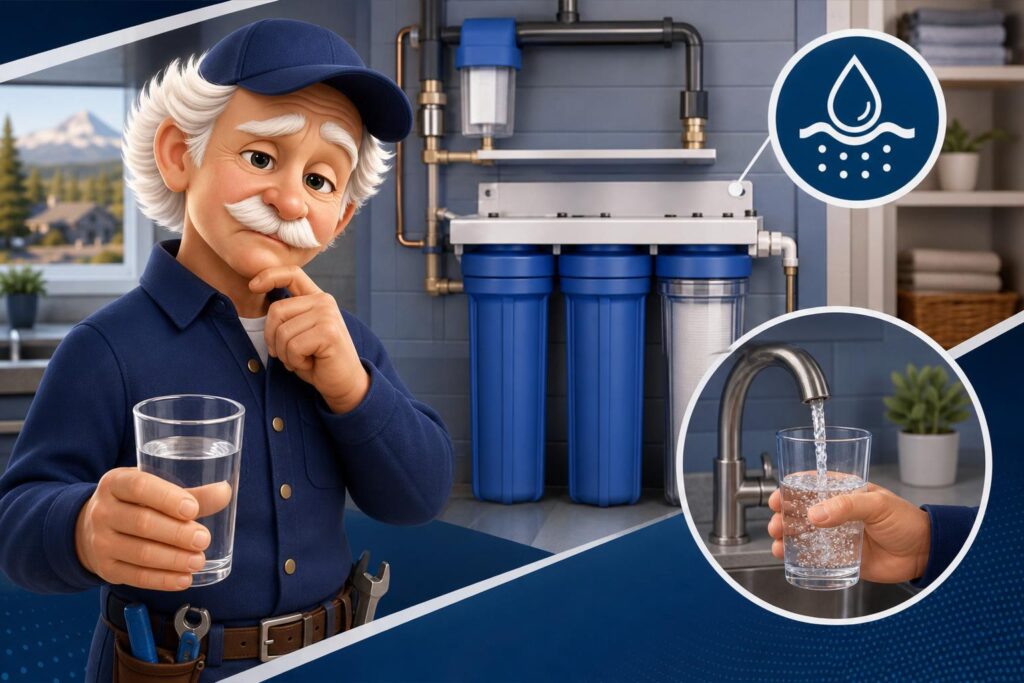
What to Check Before Scheduling Drinking Water Filtration Service in Sunriver
Before you book drinking water filtration service in Sunriver, check five things: where your water comes from (private well or community supply), what you're actually noticing in the water, whether you have a recent water test, where a filter could physically go, and whether your water heater and fixtures are showing the same symptoms. Ten minutes of prep lets a licensed plumber quote the right system the first time — and often lets you solve two problems in one visit instead of two.
Here's what to look at, in order.
1. Know your water source
Your source shapes the whole conversation.
- Private well. Common on larger lots and rural properties around Sunriver and toward La Pine. Well water quality varies property to property, so your neighbor's setup isn't a reliable guide for yours.
- Community or shared system. Treated before it reaches you, but taste, odor and hardness can still be a concern at the tap.
Write down which one you have before you call. If you bought the home recently, check your closing paperwork — well reports and prior treatment equipment are often listed there.
2. Write down exactly what you're noticing
"The water tastes funny" is a starting point. Specifics are better. Note which of these apply, and at which fixtures:
- Taste or odor — and whether it's worse on hot water, cold water, or both
- Cloudy or discolored water, or water that clears from the bottom up in a glass
- White chalky buildup on faucets, shower doors or kettle elements
- Staining in sinks, tubs or toilets
- Soap and detergent that doesn't lather well
- Sediment or grit in aerators
Also note when it happens. Water that only tastes off after the house has been empty for two weeks is a different conversation than water that's always been off.
3. Have a recent water test — or ask about one
A filter is only as good as the problem it's matched to. Carbon, sediment, softening and specialty treatment all solve different things, and buying the wrong one is an expensive way to not fix your water.
If you have a well, a current test result is the single most useful thing you can bring to the appointment. If you don't have one, say so when you request service so the technician can advise on testing before recommending equipment. It's a fair question to ask directly: *what are we treating for, and how do we know?*
4. Decide where you want treated water
This is the fork in the road, and it affects cost, placement and plumbing work.
Point-of-use (under-sink)
Treats drinking and cooking water at one fixture, usually the kitchen sink. Smaller footprint, simpler install. Check under your sink for available space, a working shutoff, and whether you have an open hole in the sink deck or countertop for a dedicated faucet.
Point-of-entry (whole-home)
Treats water as it enters the house, so showers, laundry and the water heater all get filtered or conditioned water. Check where your main line comes in — garage, crawl space, mechanical room — and whether there's room, a nearby drain if the system needs one, and power if the system requires it.
Not sure? Take a few photos of the main water line area and under your kitchen sink before the visit. That alone speeds up a real recommendation.
5. Check your water heater while you're at it
This is the step most homeowners skip, and it's the one that matters most as temperatures drop in Central Oregon.
Hard or sediment-heavy water doesn't stop at the kitchen tap. It runs through your water heater too, and mineral buildup in the tank is a common reason a unit gets noisy, slow to recover, or short on hot water. If you're already paying attention to your water quality, it's the right moment to look at the appliance that heats it.
Check for:
- Rumbling, popping or crackling sounds from the tank
- Hot water that runs out faster than it used to
- Water that comes out rusty or cloudy on the hot side only
- Moisture, rust or pooling around the base
- A unit you've never had serviced, or whose age you don't know
Find the data plate on the side of the heater and note the model and manufacture date. If you're on a tankless unit, note the last time it was descaled or serviced.
Right now, Einstein Pros is offering 5% off qualifying water heater service — a practical way to pair a filtration conversation with a hot water check before the coldest part of the season.
6. Think about how the home is actually used
Sunriver has a lot of second homes and rentals, and that changes the plan.
- Vacation and rental homes. Water sits in lines and tanks between stays. Filters still age on a calendar, not just on gallons used. Ask about service intervals that match occupancy, not a full-time household.
- Shoulder seasons and winterizing. If the home gets shut down for stretches, tell the technician. It affects equipment selection and placement.
- Guest expectations. If guests are commenting on the water, a point-of-entry system may do more than a single under-sink unit.
Einstein Pros provides preventative plumbing for vacation and rental homes in Sunriver, plus customizable HVAC maintenance plans for Sunriver vacation homes — worth bundling into one conversation if you own one.
What to have ready when you request service
- Your address and whether it's a full-time residence, second home or rental
- Well or community water
- Your symptom list and the fixtures affected
- Any water test results
- Photos of the main water line area and under-sink space
- Water heater brand, model and age
Common questions
Do I really need a water test before a plumber comes out?
Not to book the appointment — but it's the fastest route to the right system, especially on a well. If you don't have results, raise it up front so testing can be part of the plan rather than an afterthought.
Will a filtration system help my water heater?
Ask your technician to evaluate both together. Water quality and water heater condition are related, and a licensed plumber looking at the whole system can tell you whether your heater needs repair, descaling or replacement independent of what you do about filtration.
How much will it cost?
You get upfront flat-rate pricing before any work begins — no guessing partway through the job. Financing options may be available for qualifying projects; ask the team about details and approval requirements.
How fast can someone get out to Sunriver?
Same-day or next-day service is available in many cases, depending on availability and urgency. Emergency plumbing repairs are available across Central Oregon. Online service requests are typically answered quickly — often within minutes during business hours (Monday to Friday, 7:30 a.m. to 4:30 p.m., except holidays).
What else can you handle while you're here?
Sunriver plumbing service includes water heater service and replacement, drain cleaning, leak detection and pipe repair, sewer line evaluation and repair, and emergency plumbing repairs. One trip, one scope, one flat-rate price.
What to expect from the visit
- Clear scheduling confirmation before the appointment
- Licensed and insured technicians, with over 24 years of experience serving Central Oregon
- Upfront flat-rate pricing, given before work starts
- Clean job sites and transparent communication throughout
Book it
Run through the checklist, gather your notes and photos, then get on the schedule. Use the schedule a job estimate form to request service online, or call (541) 420-8888 for Sunriver and Central Oregon.
Ask about 5% off qualifying water heater service when you book.