
Tankless Water Heater Scale Buildup in Bend: What It Does and How to Fix It
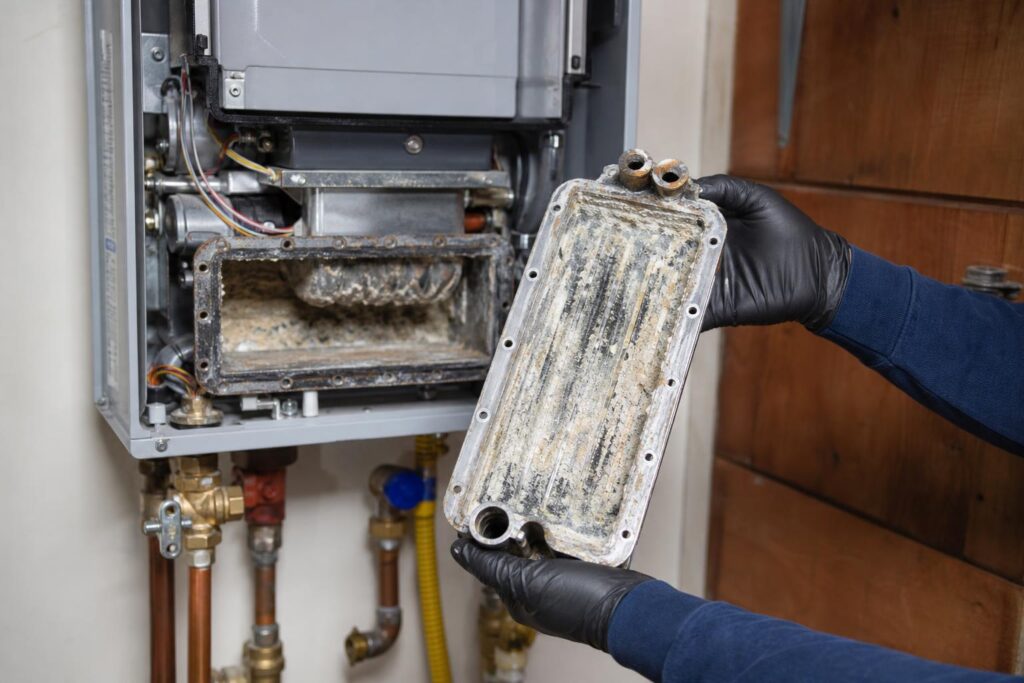
Scale is hardened mineral deposit that builds up inside your tankless water heater's heat exchanger, and it is the single most common reason a tankless unit in Bend starts running cooler, slower, or noisier than it used to. The fix is usually a professional descaling flush, sometimes paired with water treatment to slow the buildup. If the exchanger is already damaged, replacement is the better call — and a licensed technician can tell you which one you're looking at before any work starts.
Right now, we're running 5% off qualifying water heater service as temperatures drop across Central Oregon. Details below.
What scale actually is — and why tankless units feel it first
Water carries dissolved minerals. When that water is heated, some of those minerals come out of solution and stick to the hottest surfaces inside the appliance. That hard, chalky layer is scale.
A traditional tank water heater has room to hide the problem for a while — sediment settles to the bottom and sits there. A tankless unit doesn't have that luxury. It heats water on demand by pushing it through a narrow heat exchanger at high temperature. That's the exact condition minerals love.
So scale in a tankless system does two things at once:
- It insulates the heat exchanger, so the burner has to work harder and longer to hit your set temperature.
- It narrows the passages, restricting flow and raising pressure inside the unit.
Neither one fails dramatically on day one. They just quietly take your performance and your efficiency.
Signs your tankless water heater needs descaling
Homeowners usually call us about a symptom, not a diagnosis. These are the ones that point toward scale:
- Hot water that goes lukewarm mid-shower, then recovers, then drops again
- Reduced hot water flow at the tap or showerhead while cold water pressure is normal
- Longer wait times for hot water to arrive
- Rumbling, popping, or whistling from the unit when it fires
- Error codes related to flow rate, overheating, or exhaust temperature
- Flaky white or tan mineral bits showing up in aerators and fixture screens
- Higher gas usage with no change in how your household uses hot water
One symptom that's often mistaken for scale
Inconsistent hot water can also come from a failing flow sensor, a partially closed isolation valve, or a water pressure problem elsewhere in the house. That's worth saying plainly: not every lukewarm shower is a scale problem. A technician should confirm the cause before quoting a descale — otherwise you've paid for a service that didn't address the real issue.
Your options for a scaled-up tankless unit in Bend
1. Professional descaling flush
This is the standard maintenance service. A descaling solution is circulated through the heat exchanger via the unit's isolation valves to dissolve the mineral layer, then the system is flushed clean and tested.
Most manufacturers build tankless units with service valves specifically so this can be done. If your unit was installed without them, they can usually be added during the same visit — which makes every future flush faster and cheaper.
2. Descaling plus water treatment
A flush removes scale that's already there. It does nothing to stop the next layer from forming. If your home is seeing scale return quickly, treating the water upstream is the longer-term answer.
We install water filtration systems and handle water pressure regulation for homes across Bend. Pressure matters more than people expect — water that's moving too fast or too hard through the system puts added stress on the heat exchanger and on every fixture downstream.
3. Repair of a specific component
Sometimes scale has already damaged something — a flow sensor, a thermistor, a valve. Those are repairable on their own without replacing the whole unit. We'll tell you what the part is and what it costs before we touch it.
4. Replacement
If the heat exchanger itself is compromised, or if the unit has been running with heavy scale for years, replacement is often the more sensible spend. We service, repair and install both tankless and traditional water heaters, so the recommendation isn't steered toward one type. Some Bend homes are genuinely better served by a conventional tank — household size, gas line capacity, and venting all factor in.
Over 24 years serving Central Oregon. Licensed and insured technicians, upfront flat-rate pricing before any work begins, and clean job sites.
How often should a tankless water heater be flushed?
For most homes, once a year is the right rhythm — the same cadence we recommend for seasonal HVAC maintenance. Homes with harder water, high hot water demand, or a unit that's already shown scale symptoms may need it more often.
The practical test: if your tankless unit is drifting toward the symptom list above less than a year after its last flush, the interval is too long for your water, and water treatment is worth discussing.
Should I repair or replace? A straight answer
Here's the honest framework we use:
- Unit under warranty, scale-related symptoms, exchanger intact → descale and address water quality.
- Specific component failed, rest of the unit sound → repair the component.
- Heat exchanger damaged, or repeated failures stacking up → price out replacement before spending more on repairs.
- Unit is undersized for how your household actually uses hot water → replacement is the only fix that solves it, because no amount of descaling adds capacity.
We give you flat-rate pricing on each path in front of you, so the decision is yours with real numbers in hand — not a vague estimate that moves once the work starts.
What a water heater visit with Einstein Pros looks like
- Clear scheduling confirmation — you know when we're coming
- Licensed and insured technicians, with work completed to code
- Upfront flat-rate pricing presented before any work begins
- Transparent communication about what we found and what we recommend
- Clean job sites when we leave
- Same-day or next-day service in many cases, depending on availability and urgency
Financing options may be available for qualifying projects — ask the team about approval requirements.
Tankless service across Central Oregon
We handle tankless and traditional water heater service, repair and installation in Bend, Redmond, Sisters, Sunriver, La Pine, Prineville, and Madras. Our Bend office is at 63820 Clausen Rd, and regular office hours are Monday to Friday, 7:30 a.m. to 4:30 p.m., excluding holidays.
For plumbing emergencies in Bend — no hot water in a cold snap, an active leak at the unit, a burst line — we're available 24/7.
Get 5% off qualifying water heater service
Cold weather is when a struggling tankless unit stops hiding. If yours is running cooler, slower, or louder than it should, get it looked at before the deep part of winter.
Call (541) 420-8888 or request service through our job estimate and scheduling page. We aim to respond to online requests quickly — often within minutes during business hours.
Mention the water heater promotion to apply 5% off qualifying water heater service.