
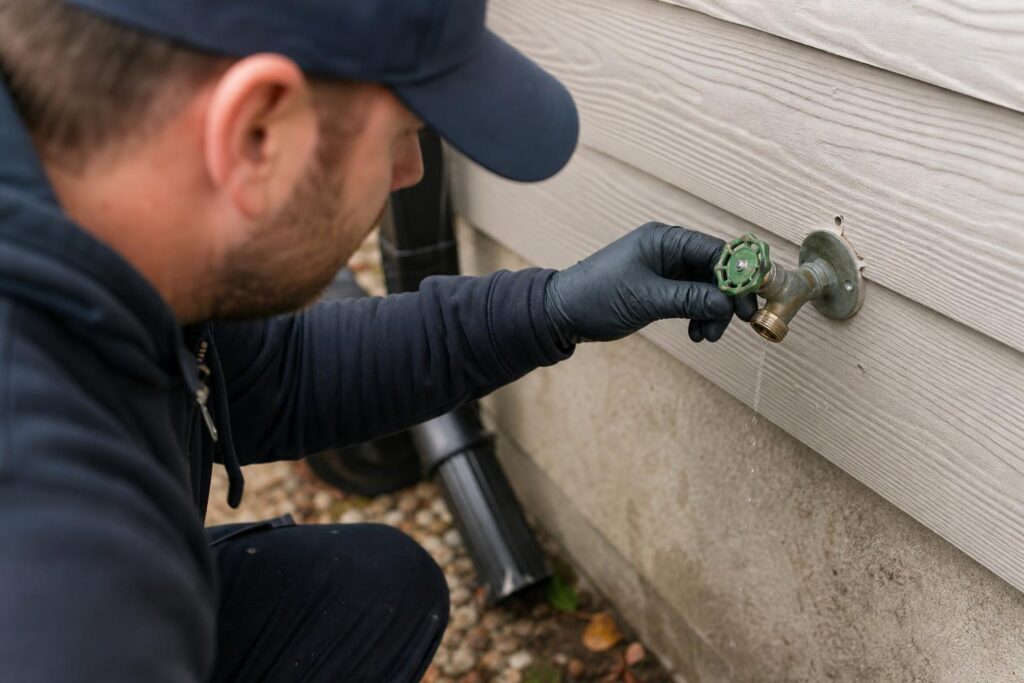
How to Winterize Outdoor Faucets and Hose Bibs Before Freezing Temperatures
To winterize an outdoor faucet, disconnect the garden hose, shut off the indoor valve that feeds that line, open the outdoor spigot to drain the water out, and leave it open through winter. That sequence takes about five minutes per faucet and it is the single most effective thing a homeowner can do to prevent a burst pipe inside an exterior wall.
Most people remember the big stuff before winter — the furnace, the crawl space, the gutters. The hose bib is the piece that gets skipped. It also happens to be one of the most common causes of winter water damage we see in homes across Central Oregon, the Portland metro, and Washington.
Why Outdoor Faucets Freeze and Split
Water expands as it turns to ice. When water sits trapped in a hose bib or the short run of pipe behind it, that expansion has nowhere to go, so it pushes outward against the pipe wall until something gives.
The damage usually happens in two stages, which is why it catches people off guard:
- The pipe or faucet body cracks during the freeze, while everything is still locked in ice. No water comes out. Nothing looks wrong.
- Days later, temperatures rise, the ice melts, and pressurized water pours out of the crack — often inside the wall cavity, under the siding, or into the crawl space.
That delay is the reason a lot of homeowners don't connect the leak to the cold snap that caused it. By then the water has been running behind drywall for hours.
The garden hose is the usual culprit
A hose left connected keeps water sitting in the faucet even if the faucet is turned off. It blocks the drain path. A coiled hose full of water also freezes solid and holds the cold right against the spigot.
If you do one thing this fall, disconnect the hoses.
How to Winterize a Hose Bib, Step by Step
Do this for every exterior faucet on the property — front, back, side yard, garage, detached shop, and any spigot near an RV pad or livestock trough.
1. Disconnect and drain every hose. Uncoil it, let it empty, and store it somewhere out of the weather. Remove splitters, timers, quick-connect fittings, and backflow devices too — they trap water.
2. Find the indoor shutoff for that line. It's usually a small valve in the basement, crawl space, garage, or utility room, on the pipe running toward the exterior wall. Close it.
3. Open the outdoor faucet fully. Let it run until it stops completely. This is the step that empties the pipe.
4. Drain the valve if it has a bleeder cap. Many indoor shutoffs have a small cap on the side. Put a cup or towel under it, loosen it, and let the remaining water in the line drain out. Snug it back up.
5. Leave the outdoor faucet open all winter. An open spigot gives any residual water somewhere to expand.
6. Insulate what's left. An insulated faucet cover over the bib adds a layer of protection, especially on north-facing walls and exposed corners.
If you can't find an indoor shutoff
Some homes — especially older ones and some single-story builds — don't have a dedicated shutoff for the exterior line. In that case, the hose bib itself is the only thing between pressurized water and the cold. Insulating the faucet helps, but it's a stopgap, not a fix.
Adding a proper shutoff valve for the outdoor line is a small, straightforward plumbing job, and it's much cheaper than repairing a wall. It's worth handling in fall rather than discovering the problem in January.
"I Have Frost-Free Faucets — Am I Covered?"
Partly. A frost-free (or frost-proof) hose bib has a long stem that places the actual shutoff seat 6 to 12 inches back inside the heated wall, so water stops well behind the freeze line. It's a real improvement over a standard spigot.
But frost-free faucets still fail, for two reasons:
- A connected hose defeats the design entirely. The frost-free stem drains by gravity through the spout. Cap that spout with a hose and the water stays in the pipe. This is the number one cause of "my frost-free faucet froze anyway."
- The faucet has to be pitched slightly downward to drain properly. If it was installed level or tilted up, water pools in the stem no matter how cold-rated it is.
So the rule holds either way: hoses off, faucet open, water drained.
Central Oregon vs. Portland and the Puget Sound
Freeze risk isn't the same everywhere we work, and the right level of prep differs.
Central Oregon — Bend, Redmond, Sisters, Sunriver, La Pine, Prineville and Madras. High desert nights drop below freezing regularly from fall through spring, and swings of 30 to 40 degrees in a single day are normal. Here, winterizing outdoor faucets isn't optional maintenance — it's standard fall practice. Insulated covers plus a drained line are the baseline.
Portland metro — Portland, Beaverton, Hillsboro, Tigard, Tualatin, Lake Oswego, Gresham, Salem and Albany. Winters are mild enough that homeowners get out of the habit, then a hard east-wind freeze arrives for three days. Unprepared hose bibs are exactly what break in those events, and the leaks show up during the thaw.
Washington — Vancouver, Tacoma, Seattle, Bremerton, Silverdale, Port Orchard, Belfair, Puyallup and Olympia. Same pattern. Long stretches of wet, mild weather followed by a short cold snap. The faucets that survive are the ones that were drained in November, not the ones someone remembered the night the forecast changed.
Vacation homes and rentals deserve extra attention
An unoccupied house has no one to notice water running. In Sunriver and across Central Oregon, a hose bib that splits in a January freeze can run unnoticed for days between guests or owner visits.
For vacation and rental properties, we recommend preventative plumbing checks before the season turns — including exterior faucets, the shutoffs that serve them, and any line running through an unheated crawl space or garage. Property managers juggling multiple homes benefit most from getting this done on one visit.
Signs Your Hose Bib Already Took Damage
Check each spigot after the first hard freeze of the season, and again during the first real thaw.
- Water dripping or spraying from the faucet body itself, not the spout
- A wet spot, stain, or bubbling paint on the siding below the faucet
- Damp insulation, a wet subfloor, or standing water in the crawl space near the exterior wall
- A faucet handle that turns but produces no water while indoor fixtures work fine
- A hissing or trickling sound inside the wall when the outdoor faucet is off
- Unexplained drops in water pressure
- A water bill that jumps with no change in usage
If you see any of these, shut off the water to that line — or the main, if you can't isolate it — and get a plumber out. Small cracks don't heal, and they don't stay small.
What to Do if a Faucet or Pipe Freezes Right Now
If a freeze is underway and no water is coming out of a fixture:
1. Shut off the water supply to that line before it thaws. That way, if the pipe cracked, it isn't under pressure when the ice melts.
2. Open the faucet so melting water and pressure have an escape route.
3. Warm the area gently — a space heater in the crawl space, a hair dryer on the exposed pipe, or opening a cabinet to let room heat in. Never use an open flame or torch.
4. Watch closely as it thaws. That's when a hidden crack reveals itself.
If a pipe has already burst, shut off the main and call. We provide emergency plumbing service throughout Central Oregon, Portland, and Washington communities including Vancouver, Tacoma, Seattle, Belfair, and Silverdale. In Bend, we're available 24/7 for plumbing emergencies.
When It's Worth Calling a Plumber Instead of DIY
Draining a hose bib is a homeowner job. These aren't:
- Replacing a cracked or seized outdoor faucet
- Installing a frost-free hose bib where a standard spigot sits now
- Adding an indoor shutoff valve for an exterior line that doesn't have one
- Repairing pipe inside a wall or crawl space after a freeze
- Correcting a poorly pitched frost-free faucet that won't drain
- Pipe repair, leak detection, or repiping where a freeze exposed older, brittle plumbing
Freeze damage often reveals the real issue — aging pipe that was already near the end of its life. If a hose bib line failed, it's worth having the rest of the run looked at while the wall is open.
What to expect when we come out: clear scheduling confirmation, licensed and insured technicians, upfront flat-rate pricing before any work begins, clean job sites, and transparent communication. Same-day or next-day service is available in many cases, depending on availability and urgency.
Frequently Asked Questions
What temperature do outdoor faucets freeze at?
Water freezes at 32°F, but exterior pipes are usually fine through a brief dip. Risk climbs sharply when temperatures stay at or below about 28°F for several hours — especially overnight, with wind, on an exposed north or east wall. In Central Oregon that happens routinely; in the Portland metro and Puget Sound it happens in concentrated cold snaps.
Should I leave my outdoor faucet dripping in cold weather?
No — not if you've winterized it properly. A drip is a technique for interior pipes that can't be drained. For a hose bib, the better approach is to shut off the supply indoors and drain the line completely. A dripping outdoor faucet with the supply still on means the pipe behind it is still full of pressurized water.
Do faucet covers alone protect an outdoor faucet?
Insulated covers help, but they only slow heat loss. They don't remove the water. Use a cover as a second layer after you've shut off and drained the line — not as a replacement for it.
How often should I check my outdoor faucets?
Twice a year is a reasonable rhythm: once in fall when you winterize, and once in spring when you turn the water back on. Turn the supply on slowly in spring and watch the faucet and the wall below it for the first few minutes. That's when a winter crack announces itself.
Does homeowner maintenance really prevent burst pipes?
It prevents the most common version of it. The hose-left-connected freeze is predictable and avoidable. Failures inside walls, under slabs, or in old pipe are different — that's where leak detection and professional pipe repair come in.
Get Your Outdoor Faucets Handled Before the First Hard Freeze
Winterizing hose bibs is quick, cheap, and dramatically cheaper than repairing water damage inside a wall. If you'd rather have a licensed plumber take care of it — or if a faucet is already dripping, seized, or leaking into the siding — we can help.
Right now, homeowners and property managers get 5% off qualifying plumbing service.
Request service on our job estimate and scheduling page at einsteinpros.com/schedule-job-estimate. We aim to respond to online requests quickly — often within minutes during business hours.
Or call the number for your area:
- Central Oregon (Bend, Redmond, Sisters, Sunriver, La Pine, Prineville, Madras): (541) 420-8888
- Portland and Vancouver, WA: (503) 821-4070
- Salem, OR: (503) 837-8470
- Tacoma, Seattle, Puyallup, Bremerton, Silverdale, Port Orchard, Belfair: (253) 533-9060
- Toll-free: (888) 671-7767
Office hours are Monday through Friday, 7:30 a.m. to 4:30 p.m., except holidays. Email us anytime at support@einsteinpros.com.