
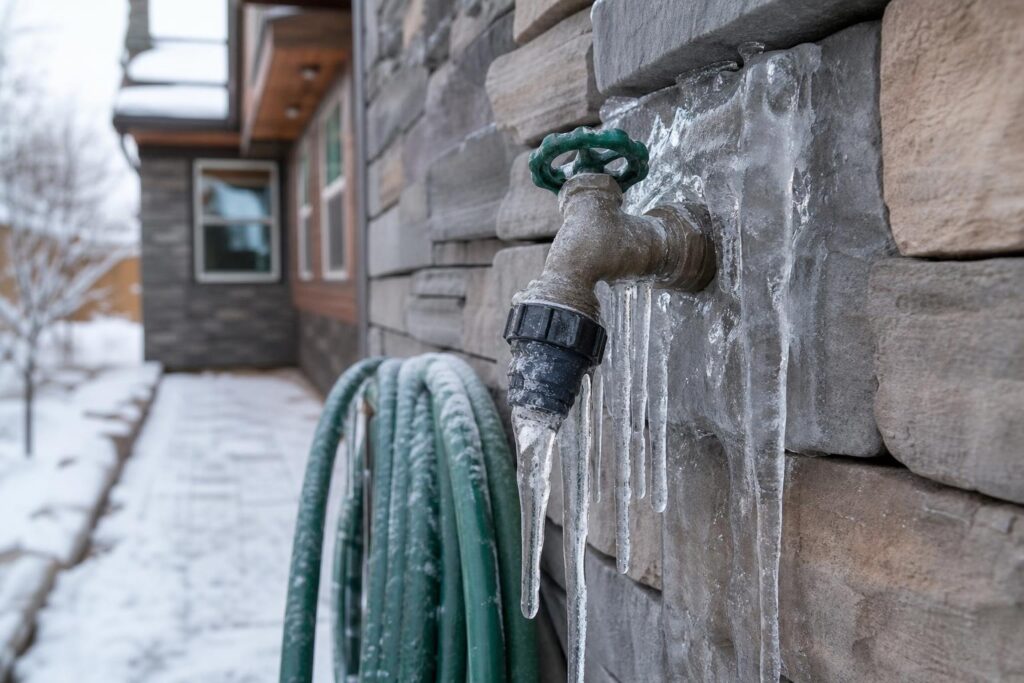
Frozen Outdoor Faucet in Central Oregon: What to Check Before You Schedule a Plumber
Before you schedule service for a frozen outdoor faucet, do four things: disconnect the garden hose, shut off the indoor valve that feeds that spigot, open the outdoor faucet to release pressure, and check the wall and ceiling directly behind it for drips or damp drywall. Those four checks tell a plumber whether you have a simple frozen hose bib or a split pipe inside the wall — and that difference changes how fast we need to get to you.
Central Oregon freeze-thaw cycles are hard on exterior faucets. Nights drop well below freezing, afternoons warm up, and the damage usually shows up on the thaw, not the freeze. Here's how to check your own setup first, so the repair visit is accurate and quick.
Step one: shut it down before you do anything else
A frozen hose bib can look harmless while it's still frozen. The ice is acting as a plug. When it thaws, water finds the crack.
- Disconnect the hose. A hose left attached traps water in the faucet body and is the single most common cause of a frozen, split spigot.
- Find the indoor shutoff. It's usually on the supply line in the crawl space, garage, basement or utility room on the other side of that exterior wall. Turn it clockwise to close.
- Open the outdoor faucet and leave it open. This relieves pressure and lets you see whether water eventually trickles out as things thaw.
- Note whether water still runs after the valve is closed. If it does, the shutoff valve isn't holding — mention that when you schedule.
If you can't locate a shutoff for that spigot, close the main water valve to the house. Knowing where the main is before a cold snap is worth the five minutes it takes to find it.
What to check before you schedule service
Walk through this list and write down what you find. It takes about ten minutes and makes the visit far more efficient.
At the faucet itself
- Does the handle turn freely, or is it stiff and locked up?
- With the valve open, is there any flow at all — a trickle, a hiss, or nothing?
- Is there a visible crack, bulge, or split in the faucet body or the first few inches of pipe?
- Is it a standard spigot or a frost-free (long-stem) hose bib? Frost-free faucets fail differently, and it helps us bring the right parts.
- Is there a vacuum breaker or backflow device on top? Those crack in a freeze too.
Inside the wall and below the floor
- Check the drywall, baseboard, and flooring directly behind and under the faucet for staining, bubbling paint or a soft spot.
- Look in the crawl space with a flashlight. Dripping, frost on a pipe, or wet insulation means the split is inside, not outside.
- Smell for musty odors near the wall — a slow leak may have been running since the last freeze.
- Check your water meter with every fixture off. If the dial is moving, water is going somewhere.
Around the rest of the house
A freeze that got one faucet often got others.
- Check every exterior spigot, including the one on the back or side of the house you rarely use.
- Check unheated spaces: garage, crawl space, well house, shop, detached garage, and any plumbing on an exterior wall.
- Run each interior fixture briefly. Low or no pressure at one sink points to a frozen or split supply line.
- Check the water heater area for standing water, since unheated garages and utility rooms take the same temperature hit.
How to tell a frozen faucet from a burst pipe
This is the detail that determines urgency.
Likely just frozen: no water flows, no visible cracks, the wall behind it is dry, and the meter isn't moving. As temperatures rise, flow returns on its own.
Likely burst: water flows but weakly, you hear running water with everything shut off, there's a wet spot on drywall or ceiling, the crawl space is dripping, or the meter is spinning with all fixtures off.
If you're seeing an active leak, a flooding crawl space, or a pipe you can see has split, treat it as an emergency. We offer emergency plumbing across Central Oregon, and in Bend we're available 24/7 for emergency plumbing. In the other Central Oregon communities — Redmond, Sisters, Sunriver, La Pine, Prineville and Madras — we schedule during business hours with priority given to urgent leaks and plumbing malfunctions.
Thawing it yourself: what helps and what causes damage
If you've confirmed there's no visible crack and no leak inside, gentle thawing is reasonable.
Do:
- Open the faucet first, so melting water has somewhere to go.
- Use a hair dryer, heat lamp, or warm towels on the faucet and the accessible pipe behind it.
- Work from the faucet back toward the house so melt water can escape.
- Open the cabinet or crawl space hatch to let warmer air reach the pipe.
Don't:
- Use an open flame, torch, or heat gun on high. That damages solder joints, PEX, and nearby framing — and is a fire risk.
- Force the handle. A frozen stem can snap off inside the valve body.
- Walk away while it thaws. Stay nearby so you can shut the water off the moment you see a leak.
If thawing brings back flow and everything stays dry, you likely got lucky. If flow returns and water starts coming out of the wall, close the shutoff and schedule a repair.
What we do on a frozen faucet call
A licensed and insured technician diagnoses the specific failure rather than guessing. That typically means:
- Isolating the line and testing whether the split is in the faucet body or the supply pipe behind it
- Replacing the hose bib or frost-free spigot, or repairing the damaged section of pipe
- Leak detection if water is showing up somewhere and the source isn't obvious
- Checking the shutoff valve that feeds the line, since old valves often fail at the same time
- Looking at the rest of the exposed plumbing in the crawl space or garage for other freeze damage
You get upfront flat-rate pricing before any work starts, plus a clear scheduling confirmation so you know when we're coming.
What to expect on every visit: clear scheduling confirmation, licensed and insured technicians, upfront flat-rate pricing, respectful and professional service, clean job sites, and transparent communication.
While a plumber is out: have the water heater looked at
The same cold snap that freezes a hose bib is the one that pushes your water heater hardest. Incoming water is colder, so the unit runs longer to hit the same temperature. Weak units tend to show it in October and November.
Worth checking before winter sets in:
- Rust-colored water or a sulfur smell at the hot taps
- Rumbling or popping from the tank, which usually means sediment buildup
- Moisture, rust, or staining at the base of the tank
- Hot water running out faster than it used to
- A tankless unit short-cycling or throwing error codes
- The unit's age — if it's been in place a long while, plan rather than react
We service, repair and install both traditional tank and tankless water heaters. If replacement is the better call, we'll say so and price it upfront. Financing options may be available for qualifying projects.
Right now: 5% off qualifying water heater service
As temperatures cool, we're running 5% off qualifying water heater service for Central Oregon homeowners. If you're already scheduling a frozen faucet repair, this is the efficient time to bundle the water heater check into the same visit.
Common questions
Is a frozen outdoor faucet an emergency?
Not by itself. A frozen spigot with no flow, no cracks and a dry wall behind it can wait for a regular appointment. It becomes an emergency when water is actively leaking inside the wall, under the house, or into a crawl space. Shut the water off and call right away in that case.
Can I just leave the faucet until spring?
Not a good idea. If the pipe behind it is already split, the first warm afternoon will send water into the wall or crawl space, often for hours before anyone notices. Isolate the line, then have it inspected.
How quickly can someone come out?
Same-day or next-day service is available in many cases, depending on availability and urgency. Online service requests usually get a response within minutes during business hours — Monday to Friday, 7:30 a.m. to 4:30 p.m., except holidays.
Does the 5% apply to repairs or only replacement?
It applies to qualifying water heater service. Tell us what you've got and what it's doing, and we'll confirm what qualifies when we give you the flat-rate price — before any work begins.
What should I have ready when I call?
Have these answers handy: which faucet, whether water flows, whether you found and closed a shutoff, whether anything is wet inside, and whether any other fixtures lost pressure. That's enough for us to scope the visit accurately.
Get it handled before the next freeze
Shut off the line, run through the checklist above, and then get it on the schedule. Call our Central Oregon team at (541) 420-8888, or use our schedule a job or estimate page to request service online — we aim to respond within minutes during business hours.
Serving Bend, Redmond, Sisters, Sunriver, La Pine, Prineville, Madras and surrounding Central Oregon communities.