
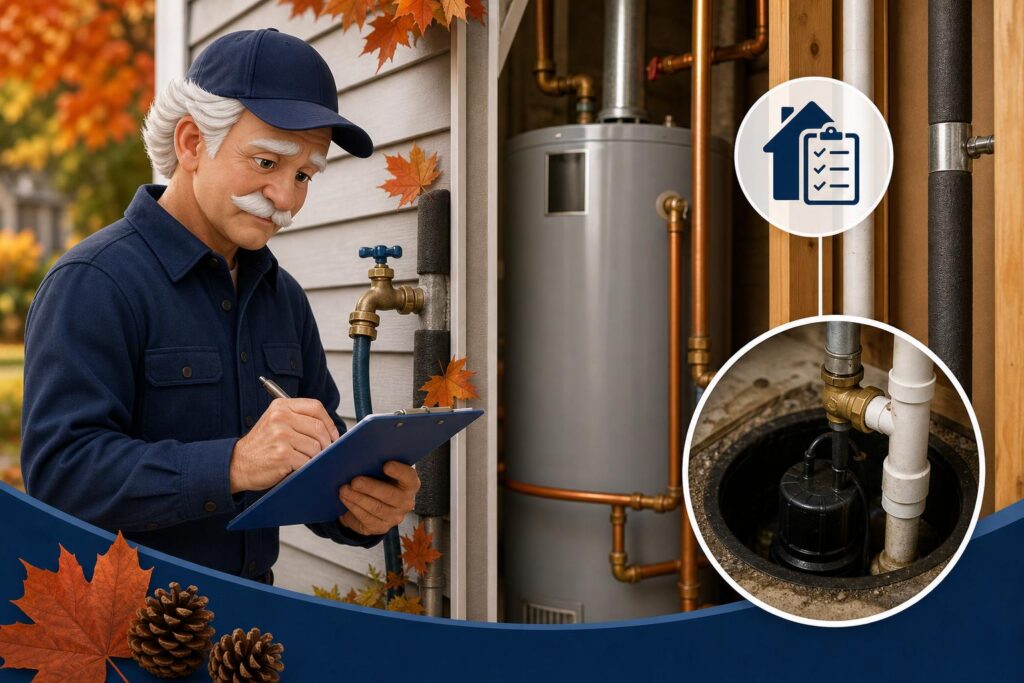
Fall Plumbing Checklist for Oregon and Washington Homes
Before temperatures drop further, check seven things: outdoor faucets and hose bibs, exposed pipes in crawl spaces and garages, your water heater, slow drains and main sewer line, your sump pump, your water pressure, and the location of your main shutoff valve. Most fall plumbing failures start as small problems you can see in early autumn and fix in a single visit — long before they become a burst pipe or a sewer backup in January.
Einstein Pros is offering 5% off qualifying preventive plumbing services this fall. Call us today and get your plumbing fall ready.
Why fall is the right time, not winter
Plumbing problems don't appear in a cold snap. They show up then.
A hose bib that drips in October is a hose bib that freezes and splits in December. A drain that gurgles in September is a partial blockage that backs up during the first heavy rain. A water heater that takes longer to recover is a water heater that fails on the coldest morning of the year, when incoming water is coldest and demand is highest.
Fall work is scheduled work. You pick the time, you get upfront flat-rate pricing before anything starts, and you're not calling for emergency plumbing at 11 p.m.
The fall plumbing checklist
Here's what to walk through, room by room and outside.
1. Outdoor faucets, hose bibs and irrigation
- Disconnect and drain every garden hose. A connected hose traps water in the bib and lets freezing damage travel back into the wall.
- Check each hose bib for drips, corrosion at the joint, or a handle that doesn't fully shut off.
- If your home has interior shutoff valves for exterior faucets, close them and open the outside spigot to drain the line.
- Insulate exposed hose bibs and any outdoor piping.
If a bib is already dripping or the valve won't seat, that's a repair to book now — not a spring project.
2. Exposed pipes in crawl spaces, garages and unheated areas
Cold air gets to pipes in crawl spaces, garages, attics and along exterior walls first. Walk the crawl space with a flashlight if you can safely get in.
Look for:
- Bare copper or PEX with no insulation
- White or green mineral crusting on fittings (a sign of a slow leak)
- Damp soil, standing water, or a musty smell
- Sagging or unsupported pipe runs
Insulating exposed lines is cheap. Repairing a burst line and the drywall under it is not. If you find damaged or repeatedly failing pipe, ask about pipe repair or whole-home repiping while the schedule is open.
3. Water heater
Your water heater works harder every month from here on. Incoming groundwater gets colder, showers get longer, and recovery time gets slower.
Signs it needs attention before winter:
- Rust-colored or metallic-smelling hot water
- Popping, rumbling or banging from the tank (sediment buildup)
- Moisture, rust or pooling at the base
- Hot water that runs out faster than it used to
- A tank that's simply old and hasn't been serviced
We service, repair and install both traditional tank and tankless water heaters. If you're weighing a repair against a replacement, we'll give you the flat-rate number for both before any work begins. Tankless is worth asking about if you're already facing a replacement and want to free up floor space or change how the home handles hot water demand.
4. Drains — before the holidays, not during
Kitchen drains take the worst of it between October and January. Fats, oils and grease from cooking cool and coat the inside of the line, and the pipe narrows a little more each week.
Check for:
- Sinks and tubs that empty slower than they did in summer
- Gurgling from a nearby fixture when another one drains
- Recurring odors from a floor drain or kitchen sink
- Garbage disposal that hums, jams or backs up into the second basin
Drain cleaning clears the immediate clog. Hydro jetting scours the pipe wall itself and restores proper flow — it's the better call for a line that keeps clogging, a restaurant-grade grease problem, or a main line with buildup.
5. Sewer line — the one people skip
This is the item most homeowners leave off the list, and it's the one that causes the worst fall and winter damage.
Wet season means saturated soil, shifting ground and root systems chasing water into pipe joints. A sewer line that's been slowly failing all summer often gives out during the first sustained rain.
A sewer inspection puts a camera in the line and shows you what's actually there: roots, a belly, a crack, an offset joint, or nothing at all. If there is a problem, we can talk about trenchless repair options or full sewer line replacement with real pricing — not guesswork.
Book an inspection now if you have:
- A history of backups
- Mature trees between the house and the street
- An older home with clay or cast-iron drain lines
- Multiple fixtures draining slowly at the same time
6. Sump pump and crawl space drainage
If you have a sump pump, test it before the rain arrives. Pour water into the pit and confirm the pump kicks on, moves water, and shuts off cleanly. Check that the discharge line is clear and directs water away from the foundation.
A sump pump that failed quietly in August is discovered in November, usually by a flooded crawl space. We handle sump pump installation and repair.
7. Water pressure, shutoff valve and leak check
- Water pressure: Pressure that's too high stresses every fitting, hose and appliance connection in the house. Water pressure regulation is a small job that protects a lot of plumbing.
- Main shutoff: Find it. Turn it. Make sure it actually closes and that everyone in the house knows where it is. In an emergency, this is the difference between a wet floor and a flooded one.
- Hidden leaks: Watch for unexplained increases in your water bill, warm spots on a floor, a running toilet, or the sound of water when nothing is on. Professional leak detection finds it without tearing the house apart.
8. Fixtures, toilets and gas connections
Fall is a good window for the small jobs you've been putting off: a toilet that rocks or runs, a faucet that won't stop dripping, a garbage disposal on its last legs, a fixture replacement you've delayed. These are quick, flat-rate items that are far easier to schedule now than in the middle of a cold snap.
If you're adding a gas appliance, fire pit or BBQ hookup, we handle gas line installation and repair. In Washington, all gas line work meets Washington State plumbing and safety codes.
What this looks like for property managers and commercial buildings
If you manage multiple units or a light commercial property, the fall checklist scales differently. The highest-value preventive items across a portfolio are usually:
- Hydro jetting main and kitchen lines in buildings with recurring clogs
- Sewer camera inspections on older properties before the rainy season
- Water heater assessment on units where age and failure risk are known
- Backflow prevention and water pressure checks
- Documented leak detection where you've seen unexplained water use
We serve homeowners, property managers and light commercial buildings across Oregon and Washington, with clear scheduling confirmation and transparent communication so you know what's happening and when.
Vacation and rental homes need a different list
An empty house in winter has no one to notice a drip. For vacation and rental homes — Sunriver in particular — the preventive priorities are exposed pipe protection, a water heater in known-good condition, drains cleared before guest turnover season, and a leak check while the property is unoccupied.
We provide preventative plumbing for vacation and rental homes in Sunriver, including sewer line evaluation and repair.
Central Oregon: pair your plumbing check with heating
If you're in Central Oregon, do both in one season. We provide heating and cooling services in Bend, Redmond, Sisters, Sunriver, La Pine, Prineville and Madras — furnace installation, repair and maintenance, heat pumps, boilers, ductless mini-splits, and indoor air quality.
Professional HVAC maintenance is recommended at least once per year for heating systems and once per year for cooling systems. If a system is more than 10–15 years old, replacement may be more cost-effective than repair.
One important note so there's no confusion: heating and cooling services are available exclusively in Central Oregon. In Portland and throughout Washington, we provide plumbing services only.
Common questions about fall plumbing maintenance
How early should I schedule fall plumbing work?
As soon as nighttime temperatures start dropping. Preventive work is scheduled work — the earlier you call, the more choice you have over timing. Waiting until the first freeze means competing with everyone else's emergency.
Do you offer same-day service?
Same-day or next-day service is available in many cases, depending on availability and urgency. For online requests, we aim to respond quickly — often within minutes during business hours.
What if my plumbing problem can't wait?
We provide emergency plumbing services throughout Central Oregon, Portland and Washington communities including Vancouver, Tacoma, Seattle, Belfair and Silverdale. In Bend, Tacoma and Puyallup, emergency plumbing response is available 24/7 for burst pipes, water leaks, overflowing toilets, sewer backups and flooding crawl spaces. Some locations, including Sisters, are served during business hours with priority scheduling for urgent leaks, sewer backups and plumbing malfunctions.
How do I know what it will cost?
You get upfront flat-rate pricing before any work begins. No surprises after the fact. Financing options may be available for qualifying projects — ask the team about details and approval requirements.
What should I expect from the visit?
Clear scheduling confirmation, licensed and insured technicians, upfront flat-rate pricing, respectful and professional service, clean job sites, and transparent communication. Repairs are completed to code.
Where we work
- Central Oregon: Bend, Redmond, Sisters, Sunriver, La Pine, Prineville, Madras — (541) 420-8888
- Portland metro and Oregon: Portland, Beaverton, Hillsboro, Tigard, Tualatin, Lake Oswego, Gresham, Albany — (503) 821-4070 · Salem — (503) 837-8470
- Vancouver, WA: (360) 768-3030
- Washington (Tacoma, Seattle, Puyallup, Bremerton, Silverdale, Port Orchard, Olympia, Belfair): (253) 533-9060
- Toll-free: (888) 671-7767
Office hours are Monday to Friday, 7:30 a.m. to 4:30 p.m., except holidays. With over 24 years of experience serving Central Oregon, our licensed and insured technicians work across Oregon and Washington.
Get your plumbing fall ready
Work through the checklist this week. Anything you can't fix yourself — a dripping hose bib, a slow drain, a water heater making noise, a sewer line you've never had inspected — book it now while the schedule is open.
Call us today at (541) 420-8888 in Central Oregon, (503) 821-4070 in Portland, or (253) 533-9060 in Washington. You can also request service online through our schedule a job or estimate page and get 5% off qualifying preventive plumbing services.