
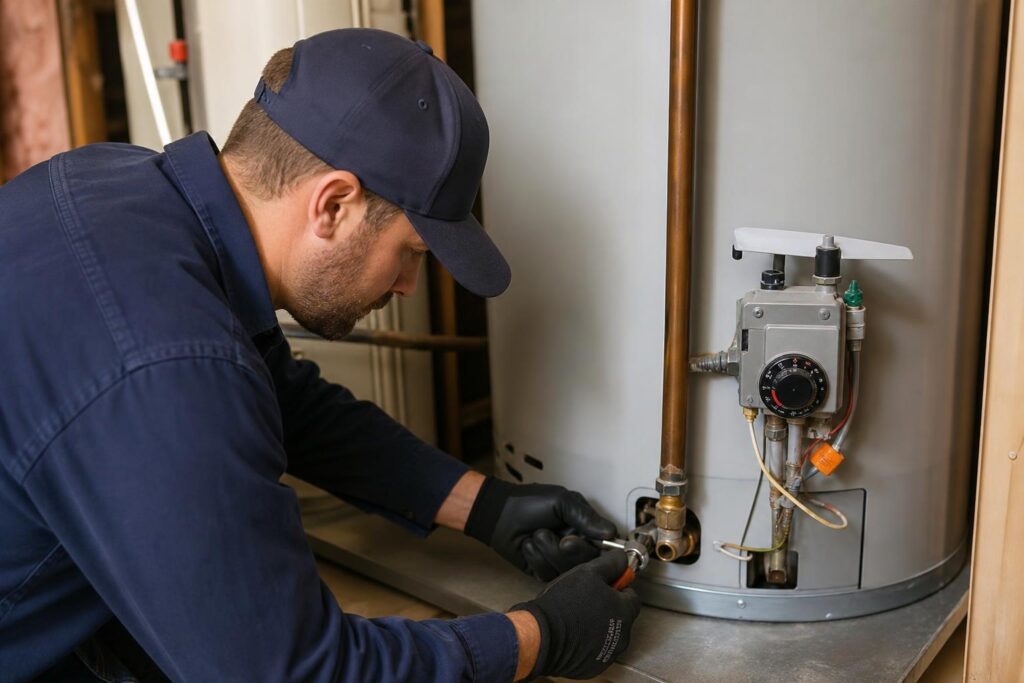
4 Water Heater Warning Signs to Fix Before You Lose Hot Water This Winter
A failing water heater almost always warns you first. The four signs to watch for are inconsistent water temperature, rumbling or popping noises, rusty or discolored hot water, and any moisture or pooling water around the tank. If you notice any of them, get the unit inspected now — not on the first freezing morning when the shower runs cold.
Water heaters work harder in winter. Incoming water is colder, so the unit runs longer to hit the same temperature. A tank that was quietly struggling in August often fails in December. Catching it early is the difference between a scheduled repair at a flat-rate price and an emergency call with no hot water in the house.
Einstein Pros installs, repairs and replaces both traditional and tankless water heaters across Central Oregon, the Portland metro area and Washington State. Right now, you can get $100 off water heater installation.
Sign 1: The temperature keeps changing
Hot water that runs lukewarm, goes cold halfway through a shower, or swings between scalding and cool is the earliest and most common warning.
What it usually means
- Sediment buildup on the bottom of the tank, insulating the burner or element from the water
- A failing heating element or burner that can no longer keep up
- A worn or drifting thermostat
- A dip tube problem, sending cold water straight to the top of the tank
- On tankless units, a scaled heat exchanger or a unit undersized for the home's demand
What to do
Note when it happens. Is it only during back-to-back showers? Only in the morning? Only at one fixture? If it's only one faucet, the problem may be that fixture, not the heater. If it's the whole house, it's the water heater.
A licensed technician can test the elements, thermostat and gas or electrical supply and tell you whether it's a part-level repair or an aging tank near the end of its life.
Sign 2: Rumbling, popping or crackling noises from the tank
A healthy tank is quiet. Banging, popping or a rumble like a kettle usually means sediment has hardened on the bottom of the tank.
Here's what's happening: minerals settle out of the water and bake into a crust. Water gets trapped underneath, boils and forces its way through — that's the popping sound. The sediment layer also traps heat against the steel, which stresses the tank and can crack the glass lining inside.
That matters because noise is not just an annoyance. It's a sign the tank is being cooked from the bottom up, and it's often the last stage before a leak.
- Popping or rumbling — sediment buildup, needs a flush or evaluation
- Ticking or tapping — often normal pipe expansion
- A screech or whistle — a restricted valve, worth having looked at
- A hum on electric units — often a loose element
If your tank has never been flushed and it's making noise, have it inspected before winter demand hits.
Sign 3: Rusty, brown or metallic-smelling hot water
Discolored water that shows up only on the hot side points at the water heater, not your supply line. That's the quick test: run the cold tap. If cold water is clear and hot water is rusty, the tank is the source.
Rust-colored hot water usually means the anode rod inside the tank is spent. That rod is a sacrificial part — it corrodes so the steel tank doesn't. Once it's gone, the tank itself starts to rust from the inside.
What this tells you about timing
Rusty hot water is a late-stage warning. It means corrosion is already underway. In some cases the anode rod can be replaced and the tank gets more life. In others, the tank is too far gone and replacement is the smarter call. A technician can tell you which one you're looking at — and give you the flat-rate price for both options before any work starts.
A metallic taste or smell in hot water only is the same story, earlier.
Sign 4: Moisture, drips or standing water around the base
Any water around a water heater deserves attention the same day. Water heaters hold 40 to 80 gallons under pressure. A slow drip is often the preview of a tank rupture.
Check these spots
- The floor and pan under the tank — pooling or a dried mineral ring means it's been leaking a while
- The temperature and pressure relief (T&P) valve — dripping here can mean excess pressure, which is a safety issue
- The drain valve at the bottom — sometimes just a loose valve, sometimes not
- The inlet and outlet connections at the top — often a fitting or connection, and usually repairable
- The seams of the tank itself — a leak from the body of the tank is not repairable, and the unit needs replacement
If water is actively running onto the floor, shut off the water supply to the heater, cut power at the breaker or set a gas unit to "pilot," and call. Emergency plumbing service is available throughout Central Oregon, Portland and Washington communities including Vancouver, Tacoma, Seattle, Belfair and Silverdale, and Einstein Pros is available 24/7 for emergency plumbing in Bend and Tacoma.
Should I repair or replace my water heater?
It depends on what failed and how old the unit is. Repair usually makes sense when a specific component has failed and the tank itself is sound — a thermostat, an element, a T&P valve, a thermocouple, a fitting or connection leak, or sediment that can be flushed.
Replacement is usually the better spend when:
- The tank body itself is leaking
- Rusty hot water shows the tank is corroding from the inside
- The unit is well past its expected service life and repairs are stacking up
- Your household has outgrown the capacity and you're always running out of hot water
You'll get upfront flat-rate pricing on both paths before any work begins, so you can compare the repair number against the replacement number and decide with real figures instead of a guess. Financing options may be available for qualifying projects — ask the team about approval requirements.
Is a tankless water heater worth considering?
It's worth a conversation if you're replacing anyway. Tankless units heat water on demand rather than holding a heated tank, and they don't have a 50-gallon tank sitting in your garage waiting to rust. They do have different venting, gas line and sizing requirements, so the right answer depends on your home.
Einstein Pros services, repairs and installs both traditional and tankless systems, so the recommendation isn't limited to one type of equipment.
How fast can someone come out?
Same-day or next-day service is available in many cases, depending on availability and urgency. Online service requests are typically answered quickly — often within minutes during business hours.
What to expect on a water heater call: clear scheduling confirmation, licensed and insured technicians, upfront flat-rate pricing before work begins, clean job sites, and transparent communication about what's wrong and what your options are.
What you can do between now and your appointment
- Note the age of your unit if you can find it on the data plate
- Listen for noise during a heating cycle
- Run the hot tap and check for color or odor
- Look under and behind the tank for moisture or a mineral ring
- Keep the area around the heater clear so a technician can access it
None of this replaces an inspection, but it gives your plumber a head start and often shortens the visit.
Where we work
- Central Oregon: Bend, Redmond, Sisters, Sunriver, La Pine, Prineville and Madras — (541) 420-8888
- Oregon Metro: Portland, Beaverton, Hillsboro, Tigard, Tualatin, Lake Oswego, Gresham, Salem and Albany — (503) 821-4070 (Salem: 503-837-8470)
- Washington: Vancouver, Tacoma, Seattle, Belfair, Silverdale, Bremerton, Port Orchard, Puyallup and Olympia — Vancouver (360) 768-3030, Tacoma and Puget Sound (253) 533-9060
Office hours are Monday through Friday, 7:30 a.m. to 4:30 p.m., except holidays. Toll-free: (888) 671-7767. Email: support@einsteinpros.com.
We serve homeowners, property managers and light commercial buildings. Technicians are licensed and insured, and repairs are completed to code.
Get your hot water ready
If your water heater is running cool, making noise, rusting your hot water or leaving moisture on the floor, book an inspection before cold weather turns it into an emergency. And if you're replacing, take the $100 off water heater installation.
Book a water heater inspection or service on the schedule a job estimate page, or call the number for your area above.