
Is Your Water Heater Ready for Fall? Warning Signs to Check Before Cold Weather Hits
Your water heater is ready for fall if it heats a full cycle without running cold, makes no rumbling or popping noise, shows no rust or moisture at the base or fittings, and has no leaks at the connections. If any one of those checks fails, get it inspected now — cold incoming water in fall and winter makes a struggling unit work harder, and that's when marginal water heaters quit for good.
Most people don't think about their water heater until there's no hot water on a cold morning. The warning signs almost always show up weeks earlier. Here's what to look for, and what to do about it.
Why Fall Is When Water Heaters Fail
Nothing magical happens in October. What changes is the workload.
Incoming water gets colder as the season turns. Your water heater has to raise that water further to reach the same temperature at the tap. A unit that was quietly limping along all summer — sediment in the tank, a weakening element, a burner that isn't firing cleanly — now has to work noticeably harder.
Add longer showers, more laundry, and houseguests over the holidays, and the demand goes up right as the margin goes down. That's the squeeze. A water heater that was "fine, mostly" in August becomes a cold shower in November.
8 Warning Signs Your Water Heater Needs Attention
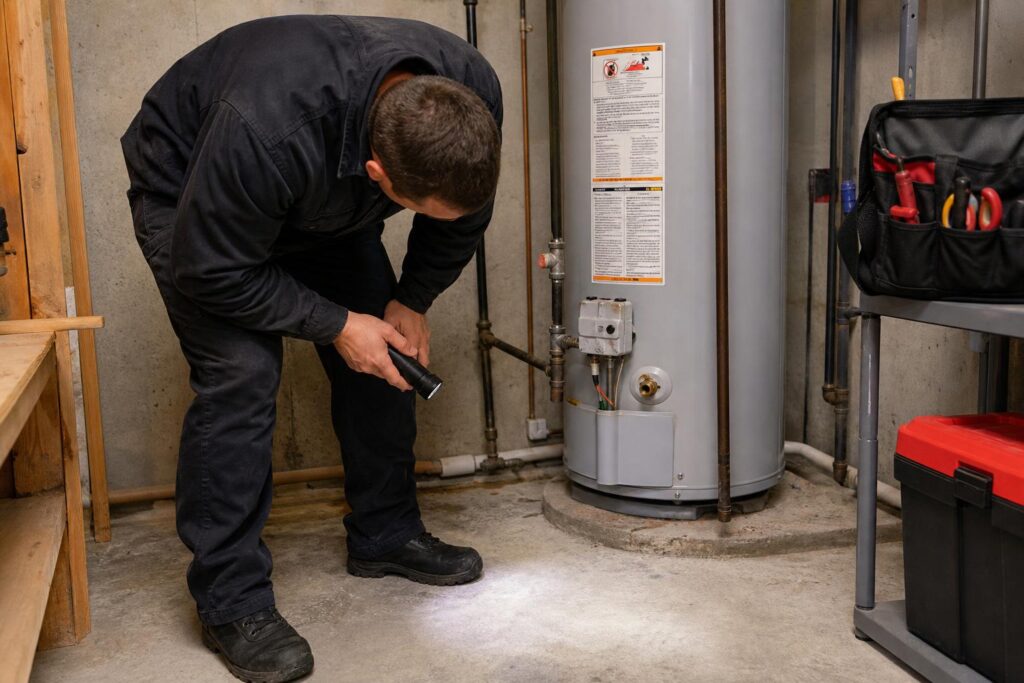
Walk down to the unit and spend five minutes with it. You're looking and listening for:
- Hot water runs out faster than it used to. Often sediment buildup taking up space in the tank, or a failing heating element.
- Rumbling, popping or crackling noises. Usually sediment hardening on the tank bottom, forcing the burner to heat through it.
- Rusty or discolored hot water. Can point to corrosion inside the tank.
- Water at the base of the unit. Even a small puddle or damp ring matters. Tanks rarely fail politely — they fail all at once.
- Rust or corrosion on the tank, fittings or connections. Surface rust at the top fittings is worth a look. Rust on the tank body usually means replacement.
- Water temperature swings. Hot, then lukewarm, then hot again during one shower.
- A pilot light that won't stay lit, or a gas unit that keeps needing a reset.
- Age. If you don't know how old it is, find the serial number on the data plate. Older units are worth evaluating before winter, not after they fail.
For tankless owners
Tankless units give different signals. Watch for a drop in flow rate, water that turns cold when two fixtures run at once, error codes on the display, or the unit short-cycling on and off. Scale buildup is the usual culprit in hard-water homes, and it's serviceable — but not if you ignore it for three more winters.
Repair or Replace? How to Decide
This is the real question most homeowners are weighing, and the honest answer depends on the failure, not a formula.
Usually worth repairing:
- Thermostat or heating element failure
- Thermocouple or igniter problems
- A leaking fitting or valve above the tank
- Sediment buildup that can be flushed
- Scale in a tankless unit
Usually worth replacing:
- The tank itself is leaking — that's not repairable
- Significant rust on the tank body
- Repeated repairs on an aging unit
- Capacity that no longer matches the household
A licensed plumber should tell you which category you're in before any work starts, along with the flat-rate cost of each path. You should be able to make the call with real numbers in front of you, not a guess.
Is a tankless water heater worth switching to?
It depends on your household and your hot water habits. Tankless units heat on demand instead of keeping a tank hot, and they don't have a tank that can eventually rust through and flood a utility room. They do have to be sized correctly for how many fixtures you run at once.
If you're replacing anyway, it's the right moment to compare both options side by side. We service, repair and install both traditional and tankless water heaters, so the recommendation isn't tied to one type.
What a Water Heater Inspection Actually Covers
An inspection isn't a glance and a shrug. A licensed and insured technician will check:
- Tank condition, base and surrounding area for moisture or corrosion
- Connections, fittings and shutoff valve
- Temperature and pressure relief valve
- Burner or heating elements and operation through a heating cycle
- Venting and gas connections on gas units
- Sediment levels and whether a flush is warranted
- Set temperature and overall performance under demand
- Age and expected remaining service life
You get a plain-language summary of what's working, what's wearing out, and what it costs to address — before anyone picks up a tool.
What to Expect When You Book
Clear scheduling confirmation, licensed and insured technicians, upfront flat-rate pricing, respectful and professional service, clean job sites, and transparent communication.
That's the standard on every water heater call. A few practical details:
- Pricing. Upfront flat-rate pricing, provided before any work begins. No surprise number at the end.
- Timing. Same-day or next-day service in many cases, depending on availability and urgency.
- Response. We aim to respond to online service requests quickly — often within minutes during business hours.
- Financing. Financing options may be available for qualifying projects. Ask the team about details and approval requirements.
- Emergencies. In Bend, we're available 24/7 for emergency plumbing. Emergency plumbing service is also available throughout Central Oregon, Portland, and Washington communities including Vancouver, Tacoma, Seattle, Belfair, and Silverdale.
Office hours are Monday to Friday, 7:30 a.m. to 4:30 p.m., except holidays.
$100 Off Water Heater Installation — Get Your Hot Water Ready
If your inspection points to replacement, you'll get $100 off water heater installation on traditional or tankless systems. It's a straightforward way to handle the job on your schedule instead of on an emergency timeline.
Where We Handle Water Heaters
Water heater repair, replacement and tankless installation are available across our full service area:
- Central Oregon: Bend, Redmond, Sisters, Sunriver, La Pine, Prineville and Madras — (541) 420-8888
- Portland metro and Oregon: Portland, Beaverton, Hillsboro, Tigard, Tualatin, Lake Oswego, Gresham, Salem and Albany — (503) 821-4070 (Salem: 503-837-8470)
- Washington: Vancouver, Tacoma, Seattle, Belfair, Silverdale, Bremerton, Port Orchard, Puyallup and Olympia — Vancouver (360) 768-3030, Tacoma/Seattle/Kitsap (253) 533-9060
We work with homeowners, property managers and light commercial buildings. In Sunriver, that includes preventative plumbing for vacation and rental homes — the ones where a failed water heater goes unnoticed the longest.
Toll-free: (888) 671-7767. Email: support@einsteinpros.com.
Book It Before the First Cold Snap
A water heater inspection this month is a short appointment. A water heater failure in January is a cold house, a wet floor, and a decision made under pressure.
Book a water heater inspection or service on our schedule a job estimate page, or call the number for your area. You'll get a clear scheduling confirmation and a flat-rate price before work begins.