
Aging Water Supply Pipes: What Happens During a Plumber's Visit in the Portland Metro Area
A professional supply pipe visit takes about one appointment. A licensed and insured plumber inspects the visible piping, tests water pressure, checks the most common failure points, performs leak detection where needed, then gives you upfront flat-rate pricing on your options before any work begins. You decide what happens next. Nothing gets opened up, cut, or replaced until you say yes to a price you've already seen.
That's the short version. Here's the full walkthrough, so you know exactly what your day looks like.
Why aging supply pipes get attention as the weather cools
Supply pipes carry pressurized water through your home around the clock. As they age, the walls thin, joints corrode, and mineral buildup narrows the inside diameter. Cold weather makes the weak spots show up faster — water temperature drops, metal contracts, and pressure changes put stress on connections that were already tired.
Fall is also when water heaters work harder. Incoming water is colder, so the heater runs longer cycles to reach the same temperature. If your supply lines are corroded or restricted, your water heater feels it first — and it's often the appliance that tips homeowners off that something upstream is wrong.
Signs it's time to have your supply pipes looked at
You don't need all of these. One or two is enough reason to book a visit.
- Water pressure that has dropped slowly over several years
- Rusty, brown, or cloudy water, especially on the first draw of the morning
- Visible green, white, or rust-colored crust on pipe joints
- Pinhole leaks, damp spots on drywall, or staining on ceilings below bathrooms
- A water meter that keeps moving when every fixture is off
- Pipes that bang, rattle, or hammer when a faucet shuts off
- Hot water that takes much longer to arrive than it used to
- A home built with galvanized steel supply lines that have never been replaced
What to expect, step by step
Before the visit: scheduling and confirmation
You book by phone or by submitting a request online. Online requests are usually answered quickly — often within minutes during business hours. You get a clear scheduling confirmation with your appointment window, so you're not waiting around all day guessing.
Office hours are Monday to Friday, 7:30 a.m. to 4:30 p.m., except holidays. Same-day or next-day service is available in many cases, depending on availability and urgency. If you have an active leak, say so when you call — active water intrusion is treated as an emergency plumbing situation.
On arrival: the walkthrough
A licensed and insured technician arrives, confirms what you're seeing, and asks a few practical questions:
- How old is the house, and has any piping been replaced?
- Is the problem in one fixture or the whole home?
- When did you first notice the pressure drop, discoloration, or noise?
- Have you had leaks or repairs here before?
Those answers narrow the search fast. A single slow bathroom usually points to one branch line. Whole-home symptoms point to the main supply or widespread corrosion.
The inspection
Next comes the hands-on part. Expect your plumber to:
- Check water pressure and look for restriction in the supply lines
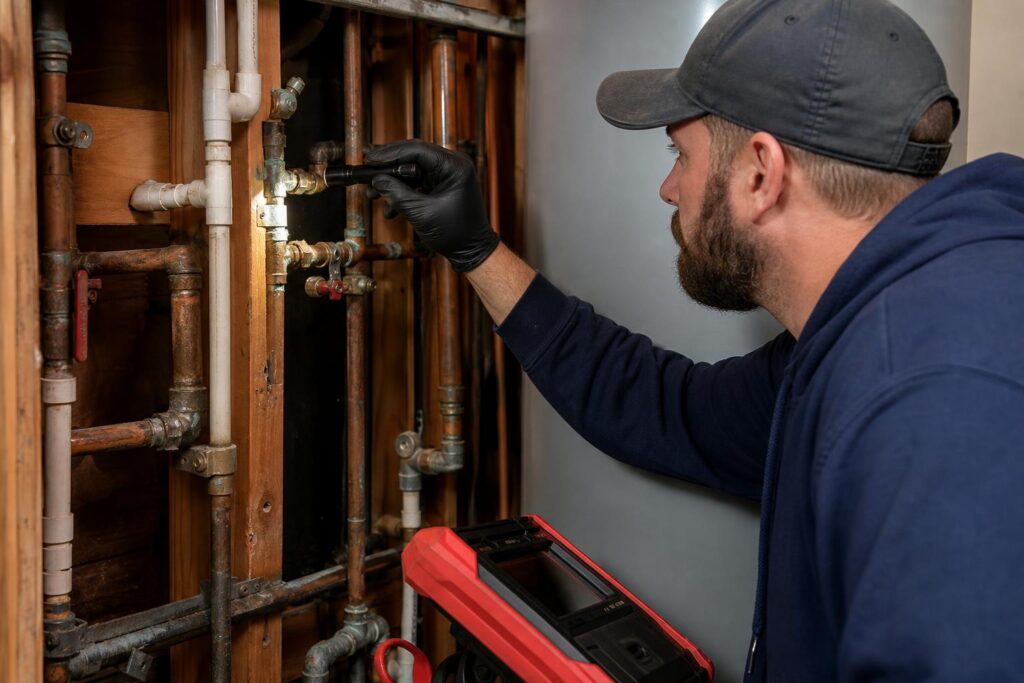
- Inspect accessible piping in the crawl space, basement, garage, and under sinks
- Identify the pipe material and look for corrosion, scale, and failing joints
- Examine the shutoff valves and supply connections at fixtures and appliances
- Inspect the water heater connections, which are a common corrosion point
- Use leak detection to locate water that's escaping behind walls, under slabs, or below floors
Leak detection matters here. Plenty of aging-pipe problems never show a puddle. The goal is to find the actual source before anyone opens a wall, not after.
The findings and your options
You get a plain-language explanation of what was found and what it means. No jargon dump. Then you get the realistic paths forward, which usually fall into three buckets:
- Targeted pipe repair — one failed section or joint, with sound piping around it
- Partial repiping — one run, one floor, or one problem material replaced
- Whole home repiping — widespread corrosion where patching just moves the next failure down the line
The price, before the work
You see upfront flat-rate pricing for each option before anything starts. Not an hourly guess that grows. A number you approve first.
What every visit includes: clear scheduling confirmation, licensed and insured technicians, upfront flat-rate pricing, respectful and professional service, clean job sites, and transparent communication.
Financing options may be available for qualifying projects. Repiping is a bigger job than a single repair, so ask about financing during the visit and the team will walk you through details and approval requirements.
The work and the cleanup
If you approve the work and the parts and schedule allow, it may be completed the same visit. Larger repipes are scheduled out, with the scope and timeline explained before you commit. Repairs are completed to code.
Job sites are cleaned up before the technician leaves. You should be able to use the space when they're gone — not be left with the cleanup.
How aging supply pipes affect your water heater
Corroded supply lines and a struggling water heater often arrive together. Sediment and rust travel downstream. Restricted inlet lines reduce flow into the tank. Corroded connections at the heater itself leak quietly for months before anyone notices the damp floor.
So while a plumber is already inspecting your supply lines, it's the right moment to assess the heater:
- Age of the unit and condition of the tank
- Corrosion at the inlet and outlet connections
- Sediment and recovery speed
- Whether repair or replacement makes more sense
- Whether a tankless unit fits how your household actually uses hot water
Water heater repair and replacement, traditional and tankless installation, are all handled by the same licensed team — so you're not coordinating two companies for one problem.
Right now, there's 5% off qualifying water heater service. If your supply pipe visit turns up a heater that's on its way out, that discount applies to qualifying work.
Repair or repipe? How the decision actually gets made
There's no magic age that forces a repipe. The honest test is whether the surrounding piping is still sound.
Repair usually makes sense when:
- The failure is isolated to one joint or section
- The rest of the system shows little corrosion
- The pipe material is still serviceable
- You've had no prior leaks in the same area
Repiping usually makes sense when:
- You've had repeat leaks in different spots
- Water quality problems show up throughout the house
- Pressure is low at every fixture, not one
- The original galvanized piping has never been touched
- You'd be paying to patch a system that's failing in several places at once
A good plumber will tell you when a repair is the smarter call. That's the point of seeing both prices before you decide.
Common questions
Do I need to be home for the visit?
Yes, for the inspection. The technician needs access to the crawl space, water heater, shutoffs, and fixtures, and you'll need to approve the flat-rate price before work begins.
How fast can someone come out?
Same-day or next-day service is available in many cases, depending on availability and urgency. Active leaks and burst lines are handled as emergency plumbing. Call the Portland line at (503) 821-4070 for the soonest opening.
Will you have to tear open my walls?
Not blindly. Leak detection is used to pinpoint the location first, so access is as limited as the repair allows. The plan — including where access is needed — is explained before any work starts.
Does this apply to rental and managed properties?
Yes. Plumbing services are provided for homeowners, property managers, and light commercial buildings across Oregon and Washington.
What areas around Portland are covered?
Portland, Beaverton, Hillsboro, Tigard, Tualatin, Lake Oswego, Gresham, Salem, and Albany, plus Central Oregon and Washington communities. Note that in the Portland metro and Washington, the service offered is plumbing — heating and cooling is available only in Central Oregon.
Book the visit
If your pressure has dropped, your water runs rusty, or your hot water isn't keeping up, get it inspected before the coldest weeks arrive. You'll get a clear explanation, a flat-rate price up front, and a plumber who tells you when a repair beats a replacement.
Call (503) 821-4070 or schedule a job estimate online — and ask about 5% off qualifying water heater service while you're booking.