
Winter Plumbing Checklist for Tacoma Homeowners: How to Prevent Frozen Pipes
To protect your Tacoma home this winter, do five things before the first hard freeze: disconnect and drain every garden hose, insulate exposed water lines in the crawl space and garage, locate and test your main water shutoff valve, seal air leaks near pipes in unheated spaces, and fix any slow drip or minor leak you've been ignoring. Most winter plumbing emergencies around Tacoma don't start with a dramatic failure — they start with a hose left attached, an uninsulated line under the house, or a small leak that finally gave way when the temperature dropped.
Here's the full checklist, in the order a licensed plumber would actually walk your house.
Why Tacoma homes are vulnerable to freeze damage
Our winters sit near the freezing line more often than they sit below it. That's exactly the problem. Cold snaps here tend to arrive fast, last a few days, and catch homes that were never fully buttoned up for winter.
A lot of Tacoma housing stock — older bungalows in the Proctor District, mid-century homes in South Tacoma and Fircrest, properties on crawl space foundations across University Place and Lakewood — has water lines running through vented crawl spaces, unheated garages, and exterior walls. Those lines are fine at 40°F. They're not fine at 25°F with wind moving through a crawl space vent.
Water expands as it freezes. The ice itself usually doesn't split the pipe at the frozen spot — pressure builds between the ice blockage and a closed faucet, and the pipe fails at the weak point. That failure often isn't discovered until the thaw, when water starts moving again and pours into a wall, ceiling, or crawl space.
Step 1: Outdoor faucets and hose bibs
This is the single most common cause of winter burst pipes in a home, and it takes ten minutes to prevent.
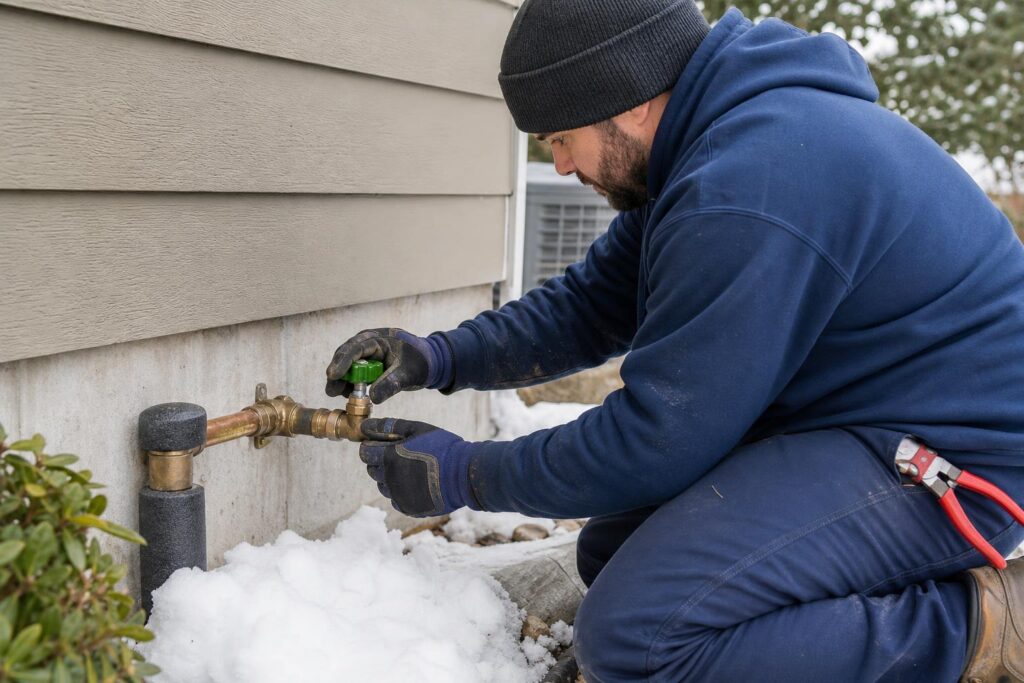
- Disconnect every garden hose. A connected hose traps water in the hose bib and the pipe behind it. That short run of pipe sits in an exterior wall, where it freezes first.
- Drain the hoses and store them in the garage or shed.
- Shut off the interior valve that feeds each outdoor faucet, if your home has one. It's usually in the crawl space, basement, or garage, near where the line exits the wall.
- Open the outdoor faucet after closing that valve so any remaining water drains out. Leave it open through winter.
- Add an insulated faucet cover to each hose bib. They're inexpensive and they work.
- Check for drips now. A hose bib that weeps when it's off is already failing, and freezing weather will finish the job.
If you have a frost-free hose bib, it still needs the hose disconnected. A frost-free design can't drain properly with a hose attached.
Step 2: Exposed water lines in crawl spaces, garages, and attics
Walk your crawl space with a flashlight before the cold arrives. You're looking for bare copper or plastic pipe with nothing around it.
- Insulate exposed hot and cold lines with foam pipe sleeves, paying extra attention to runs near crawl space vents and foundation openings.
- Seal gaps where cold air gets in — broken vent screens, missing access doors, gaps where cable or conduit enters the house.
- Check the garage. Laundry lines and utility sinks on an unheated garage wall are a frequent freeze point.
- Look at attic runs if your home has plumbing above the ceiling, especially to a second-floor bathroom.
- Note anything that looks corroded, kinked, patched, or green with oxidation. That's where the line will fail under pressure.
If your crawl space pipes are a patchwork of old repairs, that's worth a conversation about pipe repair or whole-home repiping before winter rather than after a flood.
Step 3: Find your main water shutoff — before you need it
In the middle of a burst pipe, you do not want to be learning plumbing geography.
- Locate your main shutoff. In Tacoma homes it's commonly where the water line enters the house — crawl space, garage wall, basement, or near the water heater.
- Turn it off and back on once. A valve that hasn't moved in fifteen years may be seized. Better to find that out on a dry Saturday.
- Find your water meter shutoff at the street as a backup.
- Show every adult in the house where it is. Tape a label on it.
- Keep a meter key or the right wrench somewhere obvious.
Knowing where that valve is can be the difference between a damp floor and a flooded crawl space.
Step 4: Check the water heater before you lean on it
Cold weather means longer showers, more hot water, and more demand on a system that's already working harder because incoming water is colder.
- Look underneath for rust, moisture, or mineral staining on the floor.
- Listen for popping or rumbling, which usually means sediment buildup in the tank.
- Note the age. If it's been in service a long time and recovery has gotten slow, plan the replacement instead of being surprised by it.
- Insulate exposed hot water lines coming off the unit.
- If the unit sits in a garage or unconditioned space, make sure its supply lines are protected too.
Einstein Pros services, repairs, and installs both traditional tank and tankless water heaters in Tacoma. A tankless unit can be a good fit for homes short on space, and we'll tell you honestly whether it makes sense for yours.
Step 5: Clear the drains before the holidays
Winter is when drains get tested. Extra guests, extra cooking, extra laundry, extra showers.
- Avoid putting grease, fats, or oils down the kitchen drain. They solidify in cold pipes faster than you'd expect.
- Run cold water while using the garbage disposal, and keep fibrous scraps out of it.
- Watch for slow drains, gurgling, or a toilet that bubbles when the washer drains — those point to a main line problem, not a single fixture clog.
- Clear gutters and downspouts so roof runoff moves away from the foundation instead of pooling near your crawl space.
If you have mature trees or an older sewer line
Tacoma has a lot of established neighborhoods with big trees and clay or cast-iron sewer laterals. Root intrusion and partial blockages get worse under heavy winter rain and heavier household use.
A sewer camera inspection shows exactly what's in the line instead of guessing. From there, the options are real and specific: drain cleaning, hydro jetting to scour the line back to full diameter, trenchless sewer repair, or full sewer line replacement.
Step 6: Hunt down small leaks now
A slow leak in October is a repair. The same leak in a freezing January is a burst line and wet insulation.
Signs worth acting on:
- Water meter moving when every fixture in the house is off
- A water bill that climbed without a change in habits
- Musty smell in the crawl space, cabinet, or laundry area
- Staining or soft spots on drywall, ceilings, or flooring
- Warm spots on a slab floor, which can indicate a hot water line leak
Professional leak detection finds the source without tearing open walls on a hunch. Request service online through our job estimate request form and we'll get you scheduled with a clear confirmation and flat-rate pricing before the work starts.
Step 7: Leaving town? Winterize properly
If your Tacoma home will be empty for a stretch of winter:
- Set the thermostat no lower than the mid-50s rather than shutting heat off entirely.
- Open cabinet doors under kitchen and bathroom sinks on exterior walls so warm air reaches the supply lines.
- Shut off the main water supply and drain the system if you'll be gone a long time.
- Ask a neighbor to check in — a burst pipe that runs for a week does far more damage than one caught in an hour.
What to do if your pipes freeze
If a faucet gives you nothing but a trickle during a cold snap, you likely have ice in the line. Act quickly, because the pipe hasn't burst yet.
1. Leave the faucet open. As the ice melts, open faucets give the water somewhere to go and relieve pressure.
2. Find the frozen section. It's usually the run closest to an exterior wall, crawl space vent, or unheated garage.
3. Apply gentle heat. A hair dryer, heat lamp, or space heater at a safe distance. Work from the faucet end back toward the frozen area.
4. Never use an open flame, blowtorch, or propane heater on a pipe. That's a fire risk and it can damage the pipe.
5. Watch for water as it thaws. If the pipe already split, you'll know the moment flow returns.
If you can't locate the frozen section, or water starts appearing where it shouldn't, shut off the main and call.
What to do if a pipe bursts
1. Shut off the main water supply immediately.
2. Open faucets to drain the remaining water out of the system.
3. Shut off power to any affected area if water is near outlets, fixtures, or panels.
4. Move what you can out of the water's path and start documenting the damage.
5. Call for emergency plumbing help.
Einstein Pros provides 24/7 emergency plumbing response in Tacoma, with same-day service available. Call (253) 533-9060.
Common questions from Tacoma homeowners
At what temperature do pipes freeze?
Water freezes at 32°F, but a pipe inside a wall or crawl space is insulated by the house and takes longer. The practical risk shows up when outdoor temperatures hold below freezing for several hours or more — especially overnight, and especially with wind on an exposed crawl space or exterior wall.
Should I leave my faucets dripping during a cold snap?
Yes, for fixtures on exterior walls or served by vulnerable lines. A slow drip keeps water moving and relieves the pressure that actually splits pipes. Run both hot and cold slightly. Do it for the fixtures most at risk rather than every tap in the house.
My pipes thawed and nothing leaked. Am I in the clear?
Not necessarily. Check the full run of that pipe for bulges, splits, or pinhole weeping over the next few days, and watch for new stains on ceilings and walls. Freezing stresses a pipe even when it doesn't fail outright.
Does Einstein Pros do heating work in Tacoma?
No. In Washington, including Tacoma, Einstein Pros provides plumbing services only. Heating and cooling services are available exclusively in Central Oregon.
How fast can someone get out here?
Same-day or next-day service is available in many cases, depending on availability and urgency, and emergency plumbing response in Tacoma is available around the clock. Online service requests usually get a response within minutes during business hours — Monday to Friday, 7:30 a.m. to 4:30 p.m., excluding holidays.
What to expect when you call Einstein Pros
Clear scheduling confirmation. Licensed and insured Washington State plumbers. Upfront flat-rate pricing before any work begins. Clean job sites and transparent communication.
We serve homeowners and property managers across North Tacoma, South Tacoma, Downtown Tacoma, the Proctor District, University Place, Lakewood, Fircrest, Spanaway, and Parkland, plus Puyallup and the surrounding communities. Our Tacoma plumbing work covers leak detection and pipe repair, repiping, water heater repair and replacement, tankless installation, drain cleaning and hydro jetting, sewer camera inspections and sewer line repair, fixture replacement, and emergency plumbing. All gas line work meets Washington State plumbing and safety codes.
Get your winter plumbing check on the calendar
Walk the checklist this weekend. If anything on it gives you pause — an exposed crawl space line, a hose bib that drips, a drain that's slowing down, a water heater you're not confident in — get it handled before the first freeze instead of during it.
Call Einstein Pros today at (253) 533-9060, or request service online and we'll confirm your appointment and your flat-rate price before we start.