
How to Protect Outdoor Faucets Before Freezing Temperatures in Redmond, Oregon
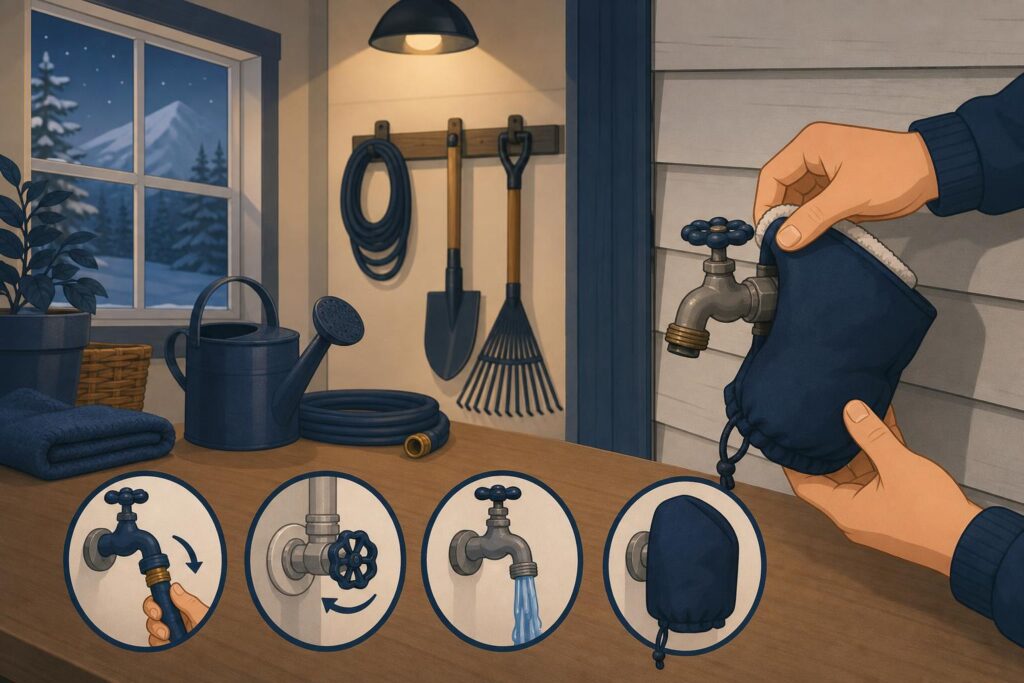
To protect an outdoor faucet before a freeze, do four things: disconnect and drain every garden hose, shut off the indoor valve that feeds the outdoor line, open the outdoor faucet to let the leftover water drain out, then cover the faucet with an insulated spigot cover. That sequence takes about ten minutes per faucet and prevents the most common winter plumbing failure homeowners in Redmond deal with — a cracked hose bib that doesn't show itself until spring.
Here's the part that catches people off guard. A frozen outdoor faucet usually doesn't leak while it's frozen. The ice is sealing the crack. The leak starts when it thaws, often inside the wall, behind drywall, or above a crawl space where nobody sees it for days.
Why Outdoor Faucets Freeze First
Your outdoor faucet is the most exposed plumbing in the house. The pipe runs through an exterior wall with little or no heat around it, and the faucet body itself sits out in the open air.
Water expands when it freezes. If there's water trapped in that faucet or in the short run of pipe behind it, the ice pushes outward with enough force to split copper, crack brass, or blow out a soldered joint. The metal doesn't stretch back. Once it's split, it's split.
Central Oregon makes this worse than a lot of places because of the swing. A sunny afternoon thaws everything out, the overnight low drops back below freezing, and that freeze-thaw cycle repeats for weeks. One hard night is a risk. Thirty of them in a row is a pattern.
The Step-by-Step: Winterizing an Outdoor Faucet
Do this before the first hard freeze, not during it. Working on a faucet that's already frozen is how small problems turn into burst pipes.
1. Disconnect every hose
This is the single most important step and the one most often skipped. A connected hose holds water against the faucet and blocks it from draining. Even a "frost-free" faucet will fail with a hose attached, because the hose traps water in the part of the valve that's supposed to drain clear.
Pull the hose off, drain it out, coil it, and store it in the garage or shed. Do the same with splitters, timers, and quick-connect fittings — those hold water too.
2. Find and close the indoor shutoff
Most homes have a dedicated shutoff valve for each outdoor faucet, usually inside on the other side of that wall. Look in the garage, the crawl space, a utility room, or the basement, near where the pipe heads outside. It may be a round handle or a quarter-turn lever.
Close it fully. If you can't find a shutoff for a given faucet, that's worth knowing now rather than in January — some older Redmond homes don't have one, and that faucet needs extra protection or a valve added.
3. Open the outdoor faucet and let it drain
With the indoor valve closed, go outside and open the spigot all the way. Water will dribble out. That's what you want — you're emptying the line between the shutoff and the faucet.
Leave it open through the winter. An open faucet gives any remaining water room to expand instead of pushing against sealed metal.
4. Drain the bleeder, if there is one
Many indoor shutoffs have a small bleeder cap or drain screw on the side. Put a cup or towel underneath, loosen it, and let the trapped water out. Snug it back up when it stops dripping.
5. Cover the faucet
An insulated faucet cover or foam dome costs a few dollars and buys real protection, especially on north-facing walls and anywhere wind hits directly. Make sure it seats flush against the siding. A cover that's hanging loose is just decoration.
6. Don't forget the ones you never use
Walk the full perimeter of the house. There's often a spigot on the back wall, one near the side gate, or one behind a shrub that hasn't been touched since summer. Unused faucets freeze the same as the ones you use daily.
Frost-Free Hose Bibs Still Need Attention
A frost-free (or frost-proof) hose bib has a long stem that puts the actual shutoff valve 6 to 12 inches inside the heated wall. Water stops well inside the house, and the exposed tube drains out on its own.
They work well. They are not maintenance-free.
- A hose left attached defeats the design. Water can't drain out, so it sits in the stem and freezes.
- They need a slight downward pitch to drain. If the faucet was installed level or tilted up, water pools inside the stem.
- The internal washer wears out. When it does, water weeps past the valve and sits in the stem all winter.
If you have frost-free bibs, you can usually skip the indoor shutoff step — but never skip disconnecting the hose.
Other Outdoor Water Lines Worth Checking
Outdoor faucets are the obvious target. These are the ones homeowners tend to forget until there's a problem.
- Irrigation and sprinkler lines — backflow devices and above-ground manifolds hold water and sit fully exposed.
- Crawl space pipes — supply lines running through an unheated or vented crawl space are at real risk, particularly near foundation vents and access doors.
- Garage and shop plumbing — utility sinks and wash-down faucets in unheated outbuildings.
- Exposed lines in the attic or along exterior walls — anywhere pipe runs outside the insulated envelope of the house.
- Well equipment and pressure tanks in unheated pump houses.
- RV and trailer hookups on the property.
How to Tell If a Faucet Already Froze
You usually find out in one of two ways.
During the freeze: You turn the faucet on and nothing comes out, or only a trickle. That means there's ice in the line. Do not use a torch or open flame on it. Shut off the water to that line, and warm the area gradually if you can reach it.
After the thaw: Watch for these signs.
- Water running inside a wall, the garage, or the crawl space when the outdoor faucet is on
- A damp patch, stain, or bubbled paint on the wall near the faucet
- A faucet that sprays from the body or the handle instead of the spout
- Water pressure that dropped elsewhere in the house
- A water bill that jumped with no change in how you use water
- Musty smell near the foundation or crawl space access
A slow leak behind a wall can run for weeks before it shows. That's where professional leak detection matters — finding the break without tearing open drywall to go looking for it.
What to Do If a Pipe Bursts
1. Shut off the main water valve to the house. Know where it is before you need it.
2. Open a few faucets inside to relieve pressure and drain the lines.
3. Shut off power to any area where water is pooling near outlets or electrical panels.
4. Move what you can out of the water's path.
5. Call a licensed plumber.
A burst supply line is an emergency. Water moves fast, and the damage it does to subfloor, insulation, and framing usually costs more than the pipe repair itself.
Common Questions from Redmond Homeowners
Should I leave a faucet dripping overnight?
Dripping an indoor faucet keeps water moving on vulnerable interior lines during an extreme cold snap. For outdoor faucets, it's not the right fix — a properly drained and shut-off outdoor line has no water in it to freeze, which is far better protection than a trickle.
I rent out my Redmond property. Who handles this?
This is a standard preventative maintenance task, and it's worth settling before winter. We work with homeowners and property managers across Central Oregon, including vacant and seasonally occupied homes where nobody is on site to notice a leak.
My house sits empty part of the winter. Is draining the faucets enough?
Not by itself. An unoccupied home has no one to catch a problem early, and interior lines matter as much as the outdoor ones. Having the plumbing looked over before you leave is a reasonable step, especially if any pipes run through an unheated crawl space.
Can I just wrap the faucet in a towel?
A towel is better than nothing in a pinch, but it absorbs moisture and then holds cold against the metal. Use a proper insulated faucet cover.
How long does a frozen pipe repair take?
It depends on where the break is and how accessible it is. A faucet replacement is straightforward. A split line inside a wall or under the house takes longer. In either case, you'll get upfront flat-rate pricing before any work starts, so you know the number before we begin.
Why Homeowners Call Einstein Pros
We've been doing plumbing in this climate for a long time, and freeze damage is something we see every winter in Redmond and across Central Oregon.
Over 24 years of experience serving Central Oregon.
What you can expect when you call:
- Licensed and insured technicians, with repairs completed to code
- Upfront flat-rate pricing given before any work begins
- Same-day or next-day service in many cases, depending on availability and urgency
- Clear scheduling confirmation, so you know when we're coming
- Clean job sites and transparent communication from start to finish
Our Redmond plumbing services cover leak detection and pipe repair, water heater repair and installation, drain cleaning and sewer services, gas line installation and repair, and emergency plumbing. We also handle repiping when a home's supply lines have taken too much damage to keep patching.
Office hours are Monday through Friday, 7:30 a.m. to 4:30 p.m., except holidays. If you'd rather not call, you can request service online through our job estimate form — we aim to respond quickly, often within minutes during business hours.
Take Ten Minutes Before the Next Cold Night
Walk the house. Pull the hoses. Close the shutoffs, open the spigots, cap them with covers. That's the whole job, and it's a lot cheaper than drying out a wall in March.
If you find a faucet that already weeps, a shutoff valve you can't locate, or a damp spot you can't explain — don't wait for it to get worse.
Call Einstein Pros today at (541) 420-8888 to schedule a plumbing inspection or leak repair in Redmond.