
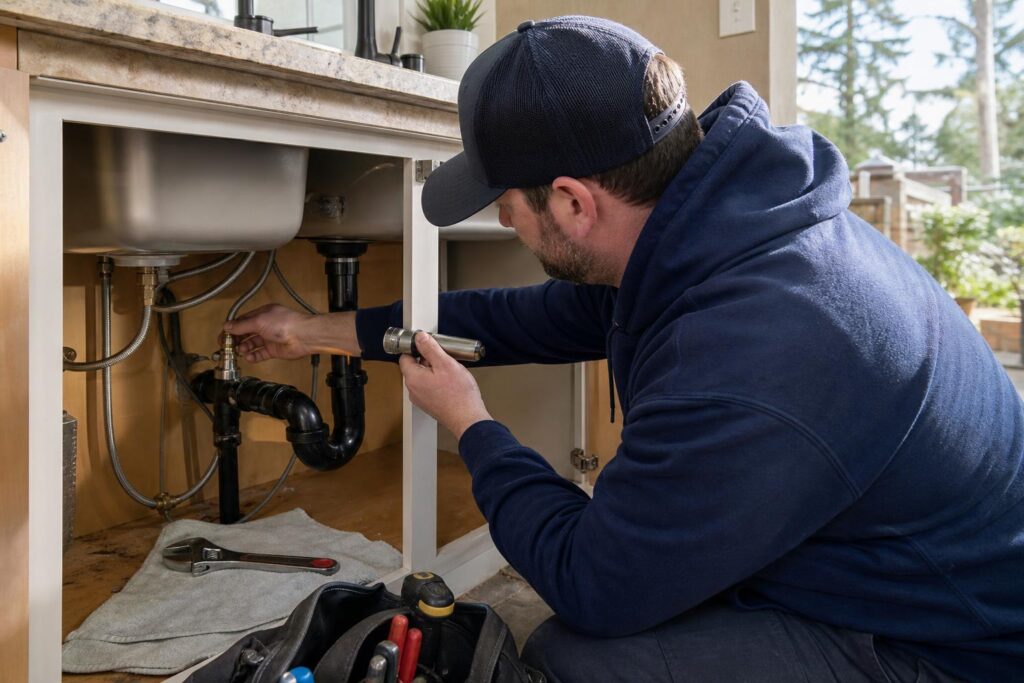
Kitchen Sink Connections in Lake Oswego: What to Check Before Winter
Before cold weather sets in, open the cabinet under your kitchen sink and check five things: the two supply lines, both shutoff valves, the P-trap, the drain connection, and the dishwasher or disposal hookup. Look for drips, white crusty buildup, soft or bulging hoses, and any dampness on the cabinet floor. A small drip in October is a flat-rate repair. The same drip behind a frozen, split line in January is a much bigger day.
Here's the plain-language version of what's under there, what winter does to it, and when it's worth calling a licensed plumber.
Why kitchen sinks get hit hardest in winter
The kitchen sink does more work in December than in any other month. Holiday cooking, more dishes, more guests, more grease down the drain, and colder water coming into the house.
In Lake Oswego, the risk is rarely the kind of deep freeze that bursts a main line. It's the combination:
- Sinks on exterior walls, where supply lines run through a cold cabinet
- Older angle stops that have been slowly weeping for months
- Drains already coated in grease, now handling heavy holiday use
- Homes with crawl spaces where the kitchen branch line sits in unheated air
None of this is dramatic on its own. Together, it's why kitchen calls spike once the temperature drops.
What's actually under your sink, in plain language
Supply lines
Two flexible hoses run from the valves up to the faucet — hot and cold. Braided stainless lines are common. The weak point is the rubber core inside the braid. It gets stiff with age, and cold makes stiff worse.
Check for: bulges, rust at the fittings, stiffness, or any green or white crust at the nut.
Shutoff valves (angle stops)
These are the small oval or football-shaped handles on the wall below the sink. They let you shut off water to the faucet without shutting off the whole house.
Check for: a handle that won't turn, a damp spot at the stem, or mineral buildup. If you can't close them by hand, you don't actually have a kitchen shutoff — and that matters a lot during an emergency.
The P-trap and drain
The curved pipe below the basin holds a small plug of water that keeps sewer gas out of your kitchen. The slip joints that hold it together use rubber washers that compress over time.
Check for: slow drips when the sink drains, a ring of water on the cabinet floor, or a smell that comes and goes.
Garbage disposal connection
Disposals leak from three places: the sink flange on top, the dishwasher inlet on the side, and the bottom seal. A bottom leak usually means the unit itself is failing, not the connection.
Check for: water tracking down the outside of the disposal body, or a hum with no grind.
Dishwasher and water filter hookups
The dishwasher drain hose, the inlet to the disposal, and any under-sink water filter or instant-hot line all add connection points. Every added fitting is another place to inspect.
A 10-minute pre-winter check you can do yourself
1. Empty the cabinet completely. You can't inspect around cleaning supplies.
2. Dry the cabinet floor with a paper towel, then look for a water stain or a swollen, dark patch in the particle board. That's a slow leak with history.
3. Run hot water for two minutes. Watch every joint while it runs.
4. Fill both basins and release them at once. A full-volume drain test finds leaks that a trickle won't.
5. Turn each shutoff valve closed and open again. If it's seized or starts weeping after you move it, stop and call a plumber.
6. Feel the supply lines. Stiff, chalky, or crusted fittings mean it's time to replace them.
7. If the sink sits on an exterior wall, check for a gap or missing insulation at the back of the cabinet where the pipes come through.
That last one is the cheapest winter protection there is. Sealing an air gap and leaving the cabinet doors open on the coldest nights lets house heat reach the pipes.
Can a kitchen sink pipe actually freeze in Lake Oswego?
Yes, though it's usually the branch line feeding the sink rather than the faucet itself. Water expands as it freezes. If that happens inside a supply line or a pipe running through an uninsulated crawl space or exterior wall cavity, the pipe can split. You often don't find out until it thaws and water starts running.
The warning sign is a faucet that suddenly delivers only a trickle on a cold morning while other fixtures run fine. If that happens, shut off the water to that fixture and call before you try to thaw anything.
The holiday grease problem nobody talks about until it's too late
Turkey drippings, gravy, butter, bacon fat, and cream-based sauces all go down the kitchen drain as a liquid and cool into a solid coating on the pipe wall. Add cold incoming water and the cooling happens faster.
A drain that's been slowing all autumn will finally back up on the day you have twelve people in the house. That's not bad luck — it's a pipe that lost most of its diameter months ago.
If your kitchen sink is already draining slowly:
- Drain cleaning clears the blockage and restores flow.
- Hydro jetting scours the pipe wall itself, which is what grease buildup actually requires.
- A sewer camera inspection makes sense if more than one fixture is slow, or if the problem keeps coming back after it's cleared.
Repeat clogs in the same drain usually point to something further down the line, not the trap under your sink.
When to stop checking and call a plumber
Call if you find any of these:
- A shutoff valve that won't close, or that drips after you turn it
- Water staining or swelling in the cabinet base
- A supply line with a bulge, rust, or visible braid damage
- A disposal leaking from the bottom
- A drain that's slow despite being cleared recently
- A faucet with dramatically reduced flow during cold weather
- Any smell of sewer gas in the kitchen
Einstein Pros handles kitchen sink work across Lake Oswego and the surrounding Oregon metro — Portland, Tigard, Tualatin, Beaverton, Hillsboro, and Gresham. That includes leak detection and water leak repair, pipe repair, faucet repair and replacement, garbage disposal repair, drain cleaning, sewer line repair, toilet repair and installation, water filtration systems, and whole home repiping.
What it costs and how scheduling works
You get upfront flat-rate pricing before any work begins. The price is quoted first, so you can decide before a wrench comes out.
What to expect on every job: clear scheduling confirmation, licensed and insured technicians, upfront flat-rate pricing, clean job sites, and transparent communication.
Right now there's 5% off qualifying plumbing repair — a straightforward seasonal discount on the kind of under-sink work described above.
Same-day or next-day service is available in many cases, depending on availability and urgency. Office hours are Monday through Friday, 7:30 a.m. to 4:30 p.m., except holidays. Online service requests usually get a response within minutes during business hours.
Financing options may be available for qualifying projects — ask when you call.
Common questions from Lake Oswego homeowners
Is a dripping shutoff valve under the sink urgent?
It's not an emergency, but don't sit on it. A weeping valve means the packing or the seat is failing. When it fails completely, it tends to do it while you're turning it — which is exactly when you needed it to work. Replace it before winter, not during a leak.
Should I leave the cabinet doors open on cold nights?
Yes, if the sink is on an exterior wall. Open the doors so warm room air reaches the pipes, and move cleaning chemicals out of reach of kids and pets first.
Does Einstein Pros do heating and cooling in Lake Oswego?
No. Heating and cooling services are available exclusively in Central Oregon. In the Portland metro area and Washington, Einstein Pros provides plumbing services only.
What should I do first if a pipe bursts under the sink?
Close both shutoff valves under the sink. If they won't turn, shut off the main water supply to the house. Then call. Emergency plumbing service is available throughout Central Oregon, Portland, and Washington communities.
Is it worth replacing supply lines that aren't leaking yet?
Usually, yes, if they're old or stiff. Replacing two braided lines is a small, planned job. Cleaning up after one fails is not.
Take ten minutes this week
Open the cabinet, dry the floor, run the water, and look. If everything's tight and dry, you're set for the season. If you find a drip, a stuck valve, or a slow drain, get it handled before holiday cooking starts.
Call Us Today at (503) 821-4070 for Lake Oswego and the Portland metro, or request a job estimate online and a licensed, insured technician will get you scheduled with a flat-rate price up front — and 5% off qualifying plumbing repair.