
Kitchen Sink Connections Explained: Hot Water, Drains and Shutoffs in Central Oregon Homes
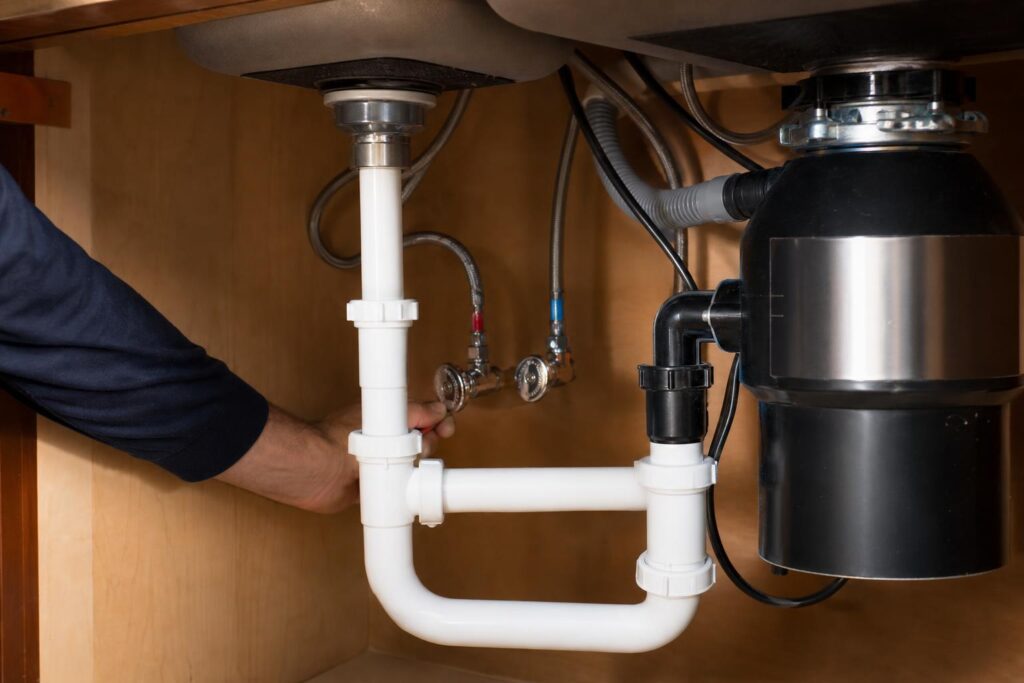
A standard kitchen sink has five connection points: a hot supply line, a cold supply line, two shutoff valves under the cabinet, a drain assembly with a P-trap, and — in most homes — a garbage disposal and a dishwasher drain hookup. When the hot side runs slow, runs cool, or takes a long time to arrive, the problem is usually one of three things: a restricted supply line or valve, a long uninsulated pipe run, or a water heater that is losing capacity.
Knowing which one you're dealing with saves you money. Below is a plain explanation of every connection under your sink, what typically fails, and when the fix is actually at the water heater instead.
What's Actually Connected Under Your Kitchen Sink
Open the cabinet door and you're looking at a small system. Each part has a job and its own failure point.
- Hot and cold supply lines. Flexible braided lines run from the shutoff valves up to the faucet. They carry pressurized water at all times, even when the faucet is off.
- Angle stop shutoff valves. Two valves, one per line. These let you isolate the sink without shutting off the whole house. Older multi-turn stops can seize up from mineral buildup and refuse to close when you need them most.
- The faucet connection. Single-handle faucets use a mixing cartridge. Two-handle faucets use separate stems. Either can restrict hot flow while cold stays fine.
- Drain assembly and P-trap. The trap holds a plug of water that blocks sewer gas from entering the kitchen. It's also where grease and food collect first.
- Garbage disposal. Hardwired or plugged in, with its own drain outlet and usually a dishwasher inlet port.
- Dishwasher drain line. Loops up to a high point or air gap, then ties into the disposal or trap arm. That loop is what keeps dirty sink water out of the dishwasher.
The connection most people forget
The dishwasher inlet port on a new garbage disposal ships with a knockout plug still in place. If it isn't removed during installation, the dishwasher won't drain. It's a five-minute issue that often gets diagnosed as a dead dishwasher.
Why Hot Water Is Slow at the Kitchen Sink
The kitchen sink is frequently the farthest fixture from the water heater. That matters more than people expect.
Every foot of pipe between the heater and the faucet holds water that has already cooled. You have to push all of it out before hot water arrives. In larger homes and properties with long runs between the garage or utility room and the kitchen, that can mean a long wait at the tap — and a lot of water down the drain.
Here's how to tell the difference between a sink problem and a heater problem:
- Hot is weak at the kitchen sink only, cold is fine. Suspect the shutoff valve, the hot supply line, or the faucet cartridge.
- Hot is weak or short-lived at every fixture. Suspect the water heater.
- Hot water arrives, then turns lukewarm within a few minutes. The heater is likely losing usable capacity.
- Hot water takes a long time to arrive but is plenty hot once it does. That's a distance and insulation issue, not a failing heater.
- You hear rumbling or popping from the tank. Sediment has built up in the bottom of the heater.
When the Kitchen Sink Is Telling You About the Water Heater
Cold weather makes every weakness in a hot water system obvious. Incoming water is colder, so the heater works harder and takes longer to recover between uses. A tank that was just barely keeping up in August can fall behind in October.
Watch for these patterns at the kitchen sink as temperatures drop:
- You run out of hot water mid-task — dishes, filling a pot, cleaning up after cooking.
- Hot water recovers much more slowly than it did in summer.
- Water at the tap looks rusty or cloudy when you first open the hot side.
- There's moisture, staining, or corrosion around the base of the tank.
If the water heater is more than 10–15 years old, replacement is often more cost-effective than another repair. We'll tell you plainly which one your situation calls for, with upfront flat-rate pricing before any work starts.
Traditional tank or tankless?
Both are worth considering, and the right answer depends on your home and how you use hot water.
- Traditional tank. Lower installed cost. Holds a fixed volume, so heavy back-to-back use can drain it. Takes time to recover.
- Tankless. Heats water on demand, so it doesn't run out the way a tank does. Takes up less space. Installation requires attention to gas supply and venting.
We service, repair and install both. If you're weighing the two, we'll walk through the trade-offs for your actual setup rather than pushing a single option.
Drain-Side Problems at the Kitchen Sink
Hot water isn't the only thing that goes wrong under a sink. Kitchen drains deal with grease, coffee grounds and food scraps, and that mix builds a lining inside the pipe over time.
- Slow drain at one sink. Usually a localized clog in the trap or trap arm.
- Gurgling when the dishwasher drains. Often a venting or partial blockage issue.
- Backup into a second fixture. The restriction is further down the line, not under the sink.
- Repeat clogs every few months. Snaking is only clearing a channel through the buildup. Hydro jetting scours the pipe wall and restores proper flow.
If backups involve multiple fixtures or the lowest drains in the house, that points to the main line. A sewer camera inspection shows exactly what's happening instead of guessing — and gives you real information before anyone talks about repair options.
What You Can Check Before You Call
A few safe checks that take under ten minutes:
1. Look for drips at both supply line connections and at the shutoff valve bodies.
2. Feel for moisture at the back of the cabinet and along the floor of the cabinet base.
3. Open the hot and cold sides separately and compare flow.
4. Check that both shutoff valves are fully open.
5. Look at the water heater itself: check the manufacture date on the label, and check the floor around the tank for water.
Don't attempt gas line work, tank draining on a heater you're unsure about, or valve replacement if the shutoff won't close. Those are the ones that turn into emergencies.
Why Homeowners Here Call Us
We serve Bend, Redmond, Sisters, Sunriver, La Pine, Prineville and Madras, along with the Portland metro area and Washington. Our technicians are licensed and insured, and repairs are completed to code.
What to expect: clear scheduling confirmation, licensed and insured technicians, upfront flat-rate pricing before work begins, clean job sites, and transparent communication throughout.
Same-day or next-day service is available in many cases, depending on availability and urgency. In Bend, we're available 24/7 for emergency plumbing. We've been serving Central Oregon for over 24 years. Financing options may be available for qualifying projects — ask us about approval requirements.
Common Questions
Is a slow kitchen sink faucet a plumbing problem or a water heater problem?
Test the cold side. If cold runs strong and hot runs weak at that one sink, the issue is almost always at the sink — valve, supply line or faucet cartridge. If hot is weak everywhere in the house, the water heater is the place to look.
Can I replace a kitchen sink shutoff valve myself?
You can, but only if the main water shutoff for the house works and you can reach it. If the angle stop is seized, corroded, or soldered to copper, call a plumber. A valve that fails mid-repair floods the cabinet and the floor underneath.
Will a new water heater fix the wait for hot water at my kitchen sink?
Not by itself. A new heater fixes capacity and recovery problems. It does not change how long the water takes to travel through the pipe. If the wait is your main complaint, the conversation should be about pipe runs and insulation, and we'll say so.
Does the 5% discount apply to repairs or only replacements?
It applies to qualifying water heater service — repair or replacement. Mention it when you book so we can apply it to your flat-rate quote.
Take 5% Off Your Water Heater Service
Temperatures are dropping, and that's when marginal water heaters start to fail. Get ahead of it.
Call (541) 420-8888 for Central Oregon, or use our schedule a job estimate form to request service online. We aim to respond to online requests quickly — often within minutes during business hours, Monday through Friday, 7:30 a.m. to 4:30 p.m.
Ask for 5% off qualifying water heater service when you book.