
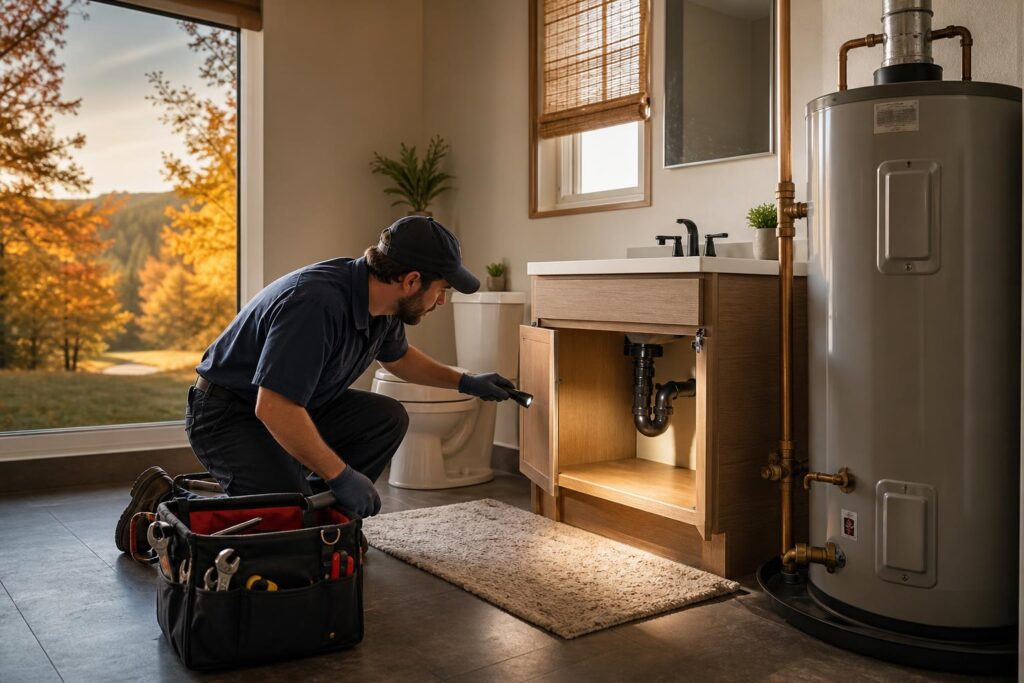
Hidden Fall Leak Check: How to Spot a Water Leak Under Sinks, Around Toilets and Near Your Water Heater
Most hidden household leaks start in three places: the supply and drain lines under your sinks, the seal and connections at the base of your toilets, and the fittings and tank of your water heater. You can check all three yourself in about 20 minutes with a flashlight and a dry paper towel. Look for dampness, crusty white mineral buildup, rust, soft cabinet floors and musty smells — then call a licensed plumber for anything you can't dry out and keep dry.
Fall is the right time to do it. Heating season means more demand on your water heater, and a slow drip you ignore in October can turn into a soaked subfloor by February. A 20-minute walkthrough now is the cheapest plumbing work you'll ever do.
Why Fall Is the Best Time to Check for Hidden Leaks
Small leaks rarely announce themselves. They soak into cabinet bases, wick into drywall and sit under a water heater pan until the damage is visible — and expensive.
Checking in fall gives you a head start for three reasons:
- Temperatures drop. Pipes and fittings contract and expand, and marginal connections start to seep.
- Water heaters work harder. Cold incoming water means longer run times and more stress on an aging tank.
- You're indoors more. Guests, holiday cooking and more showers mean more water moving through the same fixtures.
Finding a drip in October is a repair. Finding it after it has been running behind a wall all winter is a repair plus repiping, plus drywall, plus flooring.
What You Need for the Walkthrough
- A flashlight or phone light
- Dry paper towels
- A dry rag to wipe and mark
- Your phone camera, to photograph anything questionable
Do this check when no one has used water for an hour or two. Dry surfaces make wet spots obvious.
Step 1: Check Under Every Sink
Open the cabinet doors under the kitchen sink, every bathroom vanity, the laundry sink and any wet bar or basement sink. Pull everything out. Most homeowners have never seen the back corner of that cabinet.
What to look at
- The shutoff valves on the hot and cold supply lines. Wrap a dry paper towel around each valve stem and leave it a few minutes. Any dampness means a seep.
- The supply line connections where the braided or plastic lines meet the faucet and the valve. Look for green or white crusty mineral deposits — that's dried, evaporated leak residue.
- The P-trap and drain arm. Run the faucet for 60 seconds, then feel around every joint with a dry towel.
- The garbage disposal. Check the underside of the unit and the dishwasher drain hose connection. Disposals commonly leak from the body itself, which means replacement rather than tightening.
- The cabinet floor. Press it with your fingers. Soft, swollen, dark or peeling means water has been sitting there a while.
The smell test
Open the cabinet and take a breath. A musty, earthy smell in a closed cabinet is water, even when you can't see it. Trust your nose.
Step 2: Check Around the Base of Every Toilet
Toilets leak in several distinct ways, and each one points to a different repair.
- Water on the floor at the base. Often a failed wax seal. The water you're seeing may be bowl water, not clean supply water, which makes it a same-day issue.
- A rocking or loose toilet. Movement breaks the seal. If it shifts when you sit down, it needs to be pulled, resealed and reset.
- Sweating or dripping at the tank bolts or the tank-to-bowl connection. Check the floor directly behind the bowl.
- A running or refilling tank. If you hear it cycle on when nobody flushed, the flapper or fill valve is leaking water continuously into the bowl. That one shows up on your water bill, not your floor.
- Discolored or lifting flooring around the base. That means the leak has been there long enough to reach the subfloor.
A quick test for a silent toilet leak
Don't use the toilet for 30 minutes. Then look at the bowl water level and listen. Any hissing, trickling or a tank that tops itself off is a leak running 24 hours a day.
Step 3: Check the Water Heater
Your water heater is the single piece of plumbing most likely to cause a large, sudden water loss — and it usually gives you warning signs first.
Traditional tank water heaters
- Water or rust stains in the drip pan or on the floor. Any standing water under a tank should be looked at right away.
- Rust or corrosion at the top fittings where the hot and cold lines connect.
- Rust streaks down the side of the tank or around the base. Rust coming from the tank itself is not a repair — it's a failing tank.
- Moisture at the temperature and pressure relief valve or the drain valve at the bottom.
- Popping, rumbling or crackling during heating, which usually means sediment buildup.
- Age. Find the manufacture date on the label. Know the number so you're deciding on a replacement on your schedule, not during a flood.
Tankless water heaters
- Check the condensate drain line and the isolation valves for drips.
- Look for mineral buildup around fittings.
- Note any error codes on the display or hot water that runs lukewarm and then recovers.
Signs a Leak Is Hiding Somewhere You Can't See
Not every leak is under a fixture. Watch for these whole-home clues:
- A water bill that jumped with no change in how you use water
- Low or dropping water pressure at fixtures
- Warm or damp spots on a slab floor
- Stains or bubbling paint on ceilings and walls, especially below an upstairs bathroom
- The sound of running water when everything is off
- Standing water or a persistent damp smell in a crawl space
These are the cases where professional leak detection earns its keep. Rather than opening walls to guess, a plumber locates the leak first, then repairs only what needs repairing. That's the difference between pipe repair and a remodel.
What You Can Handle and What Needs a Licensed Plumber
Reasonable to do yourself:
- Snugging a visibly loose slip nut on a P-trap by hand
- Replacing a toilet flapper
- Clearing a slow bathroom sink drain of hair
- Wiping everything dry and re-checking the next day
Call a plumber for:
- Any leak at a shutoff valve or supply stop
- Water at the base of a toilet, or a toilet that rocks
- Any water, rust or corrosion at a water heater
- A soft or swollen cabinet floor or subfloor
- A leak you can't find, or a water bill spike with no visible source
- Sewer smells, gurgling drains or multiple slow drains at once — that usually points to the main line, and drain cleaning or hydro jetting clears it properly
- Anything involving a gas line near your water heater
Guessing with a pipe wrench on a corroded fitting is how a drip becomes a flood. If tightening it isn't obvious, stop.
What It Costs and How Fast We Can Get There
You get upfront flat-rate pricing before any work begins, so you know the number before a tool comes out. No hourly meter running while you watch.
Same-day or next-day service is available in many cases, depending on availability and urgency. We aim to respond to online service requests quickly — often within minutes during business hours. Office hours are Monday through Friday, 7:30 a.m. to 4:30 p.m., except holidays.
For emergency plumbing, we're available 24/7 in Bend, and we provide 24/7 emergency response in Tacoma and Puyallup. Emergency plumbing service is also available throughout Central Oregon, Portland and Washington communities including Vancouver, Tacoma, Seattle, Belfair and Silverdale.
What to expect on every visit: clear scheduling confirmation, licensed and insured technicians, upfront flat-rate pricing, respectful and professional service, clean job sites and transparent communication.
Financing options may be available for qualifying projects — contact the team for details and approval requirements.
Common Follow-Up Questions
Is water around the base of my toilet an emergency?
Treat it as urgent. The water may be coming from the bowl, which is a sanitation issue as much as a plumbing one, and the subfloor underneath starts absorbing it immediately. Shut off the supply valve behind the toilet, dry the floor and schedule service.
My water heater has a little water under it. Can I wait?
Don't wait on it. A small amount of water under a tank is often the first sign of a tank that's failing, and tanks tend to fail all at once. We service, repair and install both traditional and tankless water heaters, and we'll tell you plainly whether yours is worth repairing.
How do I know if I need leak detection or just a repair?
If you can see the leak, it's a repair. If you have the symptoms — high bill, low pressure, damp spots, running-water sound — but no visible source, start with leak detection. Locating it first almost always costs less than opening walls to find it.
Do you do heating and cooling too?
Heating and cooling services are available exclusively in Central Oregon, including Bend, Redmond, Sisters, Sunriver, La Pine, Prineville and Madras. In Portland and Washington, we provide plumbing services only. If you're in Central Oregon, fall is also the right time for seasonal HVAC maintenance — recommended at least once a year for your heating system.
Do you work with property managers?
Yes. We serve homeowners, property managers and light commercial buildings across Oregon and Washington, including preventative plumbing for vacation and rental homes.
Where We Work
- Central Oregon: Bend, Redmond, Sisters, Sunriver, La Pine, Prineville and Madras — (541) 420-8888
- Oregon Metro: Portland, Beaverton, Hillsboro, Tigard, Tualatin, Lake Oswego, Gresham, Salem and Albany — (503) 821-4070 (Salem: 503-837-8470)
- Washington: Vancouver, Tacoma, Seattle, Belfair, Silverdale, Bremerton, Port Orchard, Puyallup and Olympia — Vancouver (360) 768-3030, Tacoma and Puget Sound (253) 533-9060
Over 24 years of experience serving Central Oregon. Licensed and insured technicians, with repairs completed to code.
Found Something Damp? Book Your Service and Take 5% Off
If your fall leak check turned up moisture, mineral crust, rust or a soft cabinet floor, get it looked at now while it's still a small repair. Right now you can take 5% off qualifying plumbing service.
Book through our schedule a job estimate page and we'll confirm your appointment and give you flat-rate pricing before any work starts. Prefer to talk it through? Call the number for your area above, or email support@einsteinpros.com.