
Fall Plumbing Checklist for Oregon and Washington Homes
Before the first hard freeze, check five things: disconnect and drain outdoor hose bibs, insulate exposed pipes in crawl spaces and garages, clear slow drains, inspect and service your water heater, and look for small leaks under sinks and around fixtures. These five checks take an afternoon, and they catch the problems that turn into burst pipes, sewer backups, and no-hot-water mornings in January.
Fall is the cheapest time of year to fix a plumbing problem. A slow drain in October is a drain cleaning appointment. The same drain in December, with a full house and a holiday dinner in the oven, is an emergency call. Below is the checklist our licensed and insured technicians walk through on preventative visits across Central Oregon, the Portland metro, and Washington — plus what to do when a check turns up something you can't fix yourself.
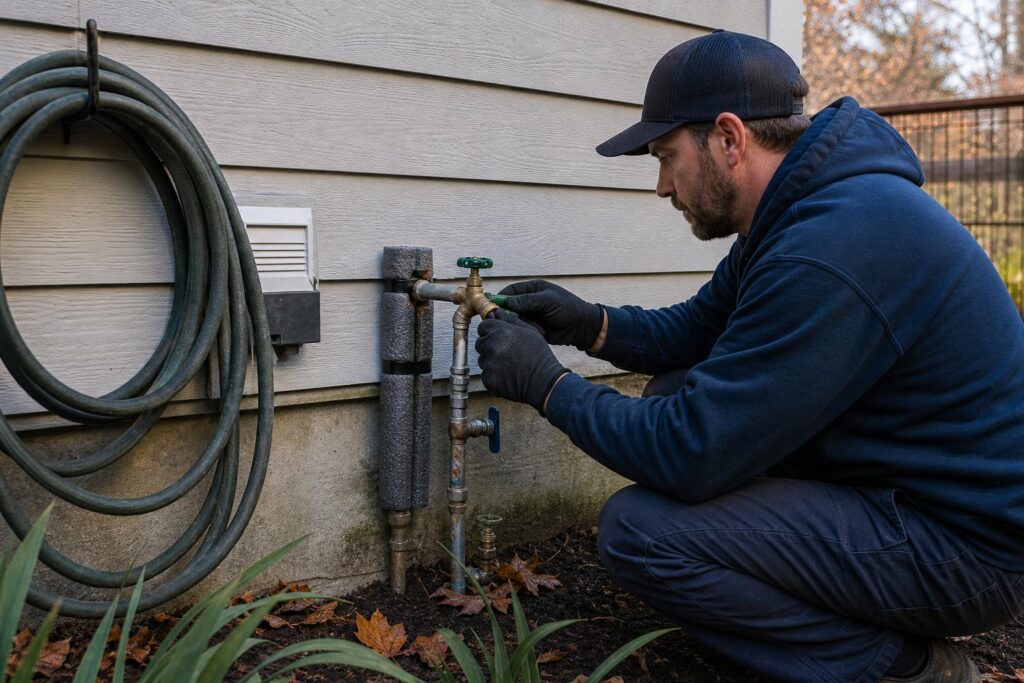
1. Disconnect and Drain Every Outdoor Hose Bib
This is the single most common cause of winter water damage in homes here, and it's the easiest one to prevent.
When a garden hose stays connected, water sits trapped in the spigot and the short run of pipe behind it. That water freezes, expands, and splits the pipe — often inside the wall. You may not know until spring, when you turn the tap on and water pours into your crawl space or garage.
Work through this for each outdoor faucet:
- Unscrew and drain garden hoses, then store them indoors or in a shed
- Open the hose bib fully and let it drain completely
- Close the interior shutoff valve if your home has one, then reopen the outside spigot to let the line drain
- Add an insulated faucet cover to each exposed bib
- Drain and shut off irrigation lines and backflow assemblies before temperatures drop
Homes in Bend, Redmond, Sisters, La Pine, Sunriver, Prineville, and Madras see harder and longer freezes than the valley, so don't wait for the forecast to warn you. In Portland, Vancouver, and the Puget Sound area, the risk is a sudden cold snap after weeks of mild weather — the freeze that catches people unprepared.
If a hose bib already drips or won't shut off
A spigot that drips after you close it has a failed washer or a cracked stem, and it will freeze from the inside out. That's a straightforward repair now and a pipe replacement later.
2. Insulate Exposed Pipes in Crawl Spaces, Garages, and Attics
Interior pipes in heated space are usually fine. The pipes that freeze are the ones in unheated space: vented crawl spaces, garages, attics, exterior walls, and under kitchen sinks on outside walls.
Walk your crawl space with a flashlight and look for:
- Bare copper or PEX with no insulation sleeve
- Pipes running close to a foundation vent or an open crawl space access
- Missing or fallen insulation between floor joists
- Water lines to a laundry sink, water softener, or utility sink in an unheated garage
- Signs of previous trouble — mineral staining, corrosion, patch clamps, or damp soil under a pipe run
Foam pipe sleeves and heat tape handle most of it. What they can't fix is old, brittle, or undersized piping. If your home still has original galvanized pipe, or you've had more than one pinhole leak in the same area, that's a repiping conversation — and one worth having before winter rather than during it. We handle leak detection, pipe repair, and whole home repiping across Oregon and Washington.
Where is the main water shutoff?
Find it now, while you're not standing in water. Make sure everyone in the house knows where it is and that the valve actually turns. A seized main shutoff is a small repair that becomes the difference between a wet floor and a flooded level.
3. Clear Slow Drains and Check Your Sewer Line
Fall is when drains get tested. Leaves and needles clog exterior drains, and the kitchen sink takes on months of cooking.
Signs your drains need attention before the holidays:
- A tub or shower that drains slower than it did in summer
- Gurgling from a toilet when the washing machine empties
- A kitchen sink that backs up when the disposal runs
- More than one fixture draining slowly at the same time — usually a main line issue, not a fixture issue
- Any smell of sewage inside or around the foundation
One slow fixture is typically a local clog. Multiple slow fixtures point to the main line, and that's where a camera inspection earns its keep. Root intrusion and offset joints are common in older Portland and Seattle-area neighborhoods, and they don't improve on their own.
Our drain and sewer work covers professional drain cleaning, hydro jetting to scour grease and buildup out of the line, sewer camera inspections, trenchless repair options, and full sewer line replacement.
Why hydro jetting instead of just snaking it?
A cable clears a path through a clog. Hydro jetting scrubs the interior wall of the pipe, removing the grease and scale that caused the clog in the first place. If the same drain backs up every few months, jetting addresses the cause, not just the symptom.
4. Inspect and Service Your Water Heater
Your water heater works hardest in winter, because incoming water is colder and your household uses more hot water. Fall is when to catch a failing unit — on your terms, not at 6 a.m. on a cold morning.
Check for:
- Rust or moisture at the base of the tank
- Water marks, corrosion, or drips at the cold and hot connections
- Rumbling or popping during heating — usually sediment on the tank bottom
- Hot water that runs out faster than it used to
- Discolored or metallic-tasting hot water
- Age — check the serial number sticker for the manufacture date
A tank holding sediment heats less efficiently and fails sooner. Flushing the tank, checking the anode rod, and testing the temperature and pressure relief valve are all part of routine service.
If your unit is nearing the end of its life, fall is the right time to weigh repair against replacement — including switching to a tankless water heater, which heats on demand and frees up the floor space a tank takes. We service, repair, and install both traditional and tankless water heaters, and you'll get upfront flat-rate pricing on either path before any work starts.
5. Hunt Down Small Leaks Now
Small leaks are cheap to fix and expensive to ignore. Cold weather makes them worse, because pipes contract and joints that were barely holding start to weep.
Spend twenty minutes checking:
- Under every sink — run your hand along the supply lines and trap, feeling for damp
- Around the base of each toilet, and at the tank-to-bowl connection
- The shutoff valves behind toilets and under sinks, where corrosion collects
- Washing machine supply hoses for bulges, cracks, or rust at the couplings
- Under the dishwasher and around the refrigerator water line
- Ceilings below upstairs bathrooms for stains or soft spots
How do I know if I have a hidden leak?
Turn off every fixture and appliance in the house, then watch your water meter. If the dial moves, water is going somewhere. A jump in your water bill with no change in habits is the other common tell. Hidden leaks inside walls, under slabs, and in crawl spaces are what professional leak detection is for — we locate the source before anything gets opened up.
Bonus for Central Oregon: Book Your Heating Maintenance Too
If you're in Bend, Redmond, Sisters, Sunriver, La Pine, Prineville, or Madras, fall is also furnace and heat pump season. We recommend professional maintenance at least once a year for your heating system and once a year for cooling.
If a heating or cooling system is more than 10–15 years old, replacement is often more cost-effective than continuing to repair it.
We also offer customizable HVAC maintenance plans for Sunriver vacation homes, which is worth a look if your property sits empty for stretches of the winter.
One important note: heating and cooling services are available exclusively in Central Oregon. In the Portland metro and throughout Washington, we provide plumbing services only.
What to Expect When You Book a Preventative Visit
No surprises. Here's how it works:
- Clear scheduling confirmation so you know when we're coming
- Licensed and insured technicians, with all repairs completed to code
- Upfront flat-rate pricing before any work begins
- Same-day or next-day service in many cases, depending on availability and urgency
- Clean job sites and transparent communication from start to finish
Financing options may be available for qualifying projects — ask the team about details and approval requirements.
For urgent problems, emergency plumbing is available throughout Central Oregon, Portland, and Washington communities including Vancouver, Tacoma, Seattle, Belfair, and Silverdale. In Bend, we're available around the clock for plumbing emergencies. Some locations, including Sisters, operate during business hours with priority scheduling for urgent leaks, sewer backups, and plumbing malfunctions.
Book Your Fall Plumbing Service and Take 5% Off
Work through the checklist. Anything you'd rather hand to a licensed pro — hose bib repair, pipe insulation, drain cleaning, a sewer camera inspection, water heater service, or leak detection — bring it to us and take 5% off qualifying plumbing service.
Request service on our schedule a job estimate page — we aim to respond to online requests quickly, often within minutes during business hours. Or call:
- Central Oregon: (541) 420-8888
- Portland & Vancouver: (503) 821-4070
- Salem: (503) 837-8470
- Tacoma, Seattle & Kitsap County: (253) 533-9060
- Toll-free: (888) 671-7767
Office hours are Monday through Friday, 7:30 a.m. to 4:30 p.m., except holidays. Email us anytime at support@einsteinpros.com.
Get it on the calendar before the first freeze.